What AI Actually Is (and Isn't)
Part 1 of 12 — Intro to AI for non-technical backgrounds
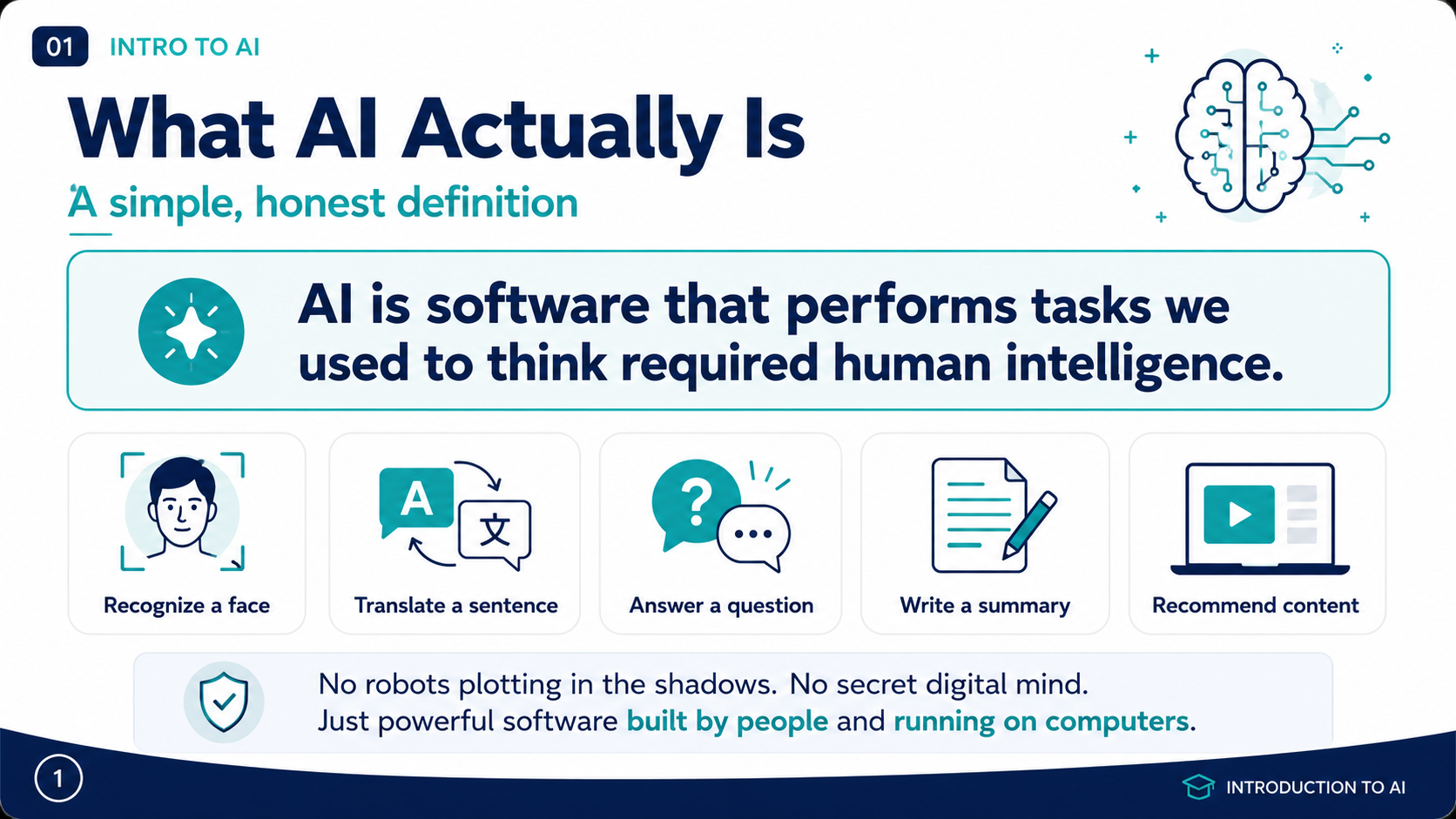
Artificial intelligence is one of the most talked about ideas of our time, and also one of the most misunderstood. Before we go any further, let us set a simple, honest definition: AI is software that performs tasks we used to think required human intelligence, such as recognizing a face, translating a sentence, answering a question, or writing a summary.
That is it. No robots plotting in the shadows, no secret digital mind with feelings. Just very capable software, built by people, running on ordinary computers. Understanding this clearly, before anything else, is worth more than any other single piece of knowledge in this course.
Why the word causes so much confusion
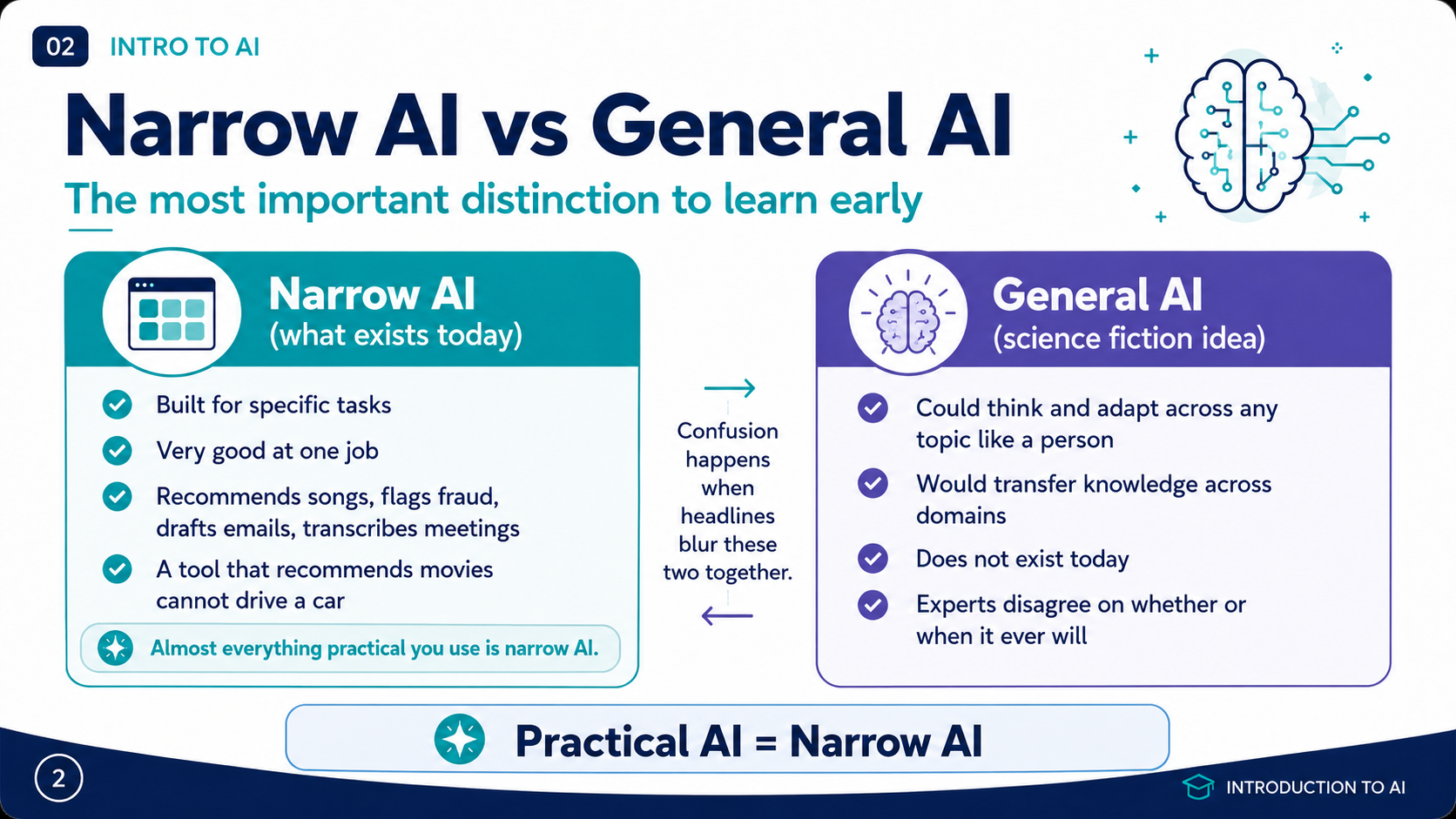
Part of the trouble is that "artificial intelligence" is used for two completely different ideas that happen to share a name. Keeping them apart is the single most useful thing you can do early on. When writers, marketers, and executives blur them together, that is where both the hype and the fear come from.
- Narrow AI is what exists today. It is software built to do specific things very well: suggest your next song, flag a suspicious transaction, draft an email, transcribe a meeting recording. Each system is good at its own job and nothing else. The tool that recommends films cannot drive a car. The tool that drives a car cannot write a legal brief. They are as different as a hammer and a scalpel.
- General AI is the science fiction version: a machine that can think, reason, and adapt across any topic the way a person can. It does not exist. Serious researchers disagree sharply about whether it ever will, and on what timeline. When a news article predicts the end of human relevance, it is almost always talking about this hypothetical second kind, not the first kind that we actually have.
Almost everything you will encounter in your professional or personal life is narrow AI. Knowing that makes the technology far less mysterious and far more useful.
What today's AI is genuinely good at
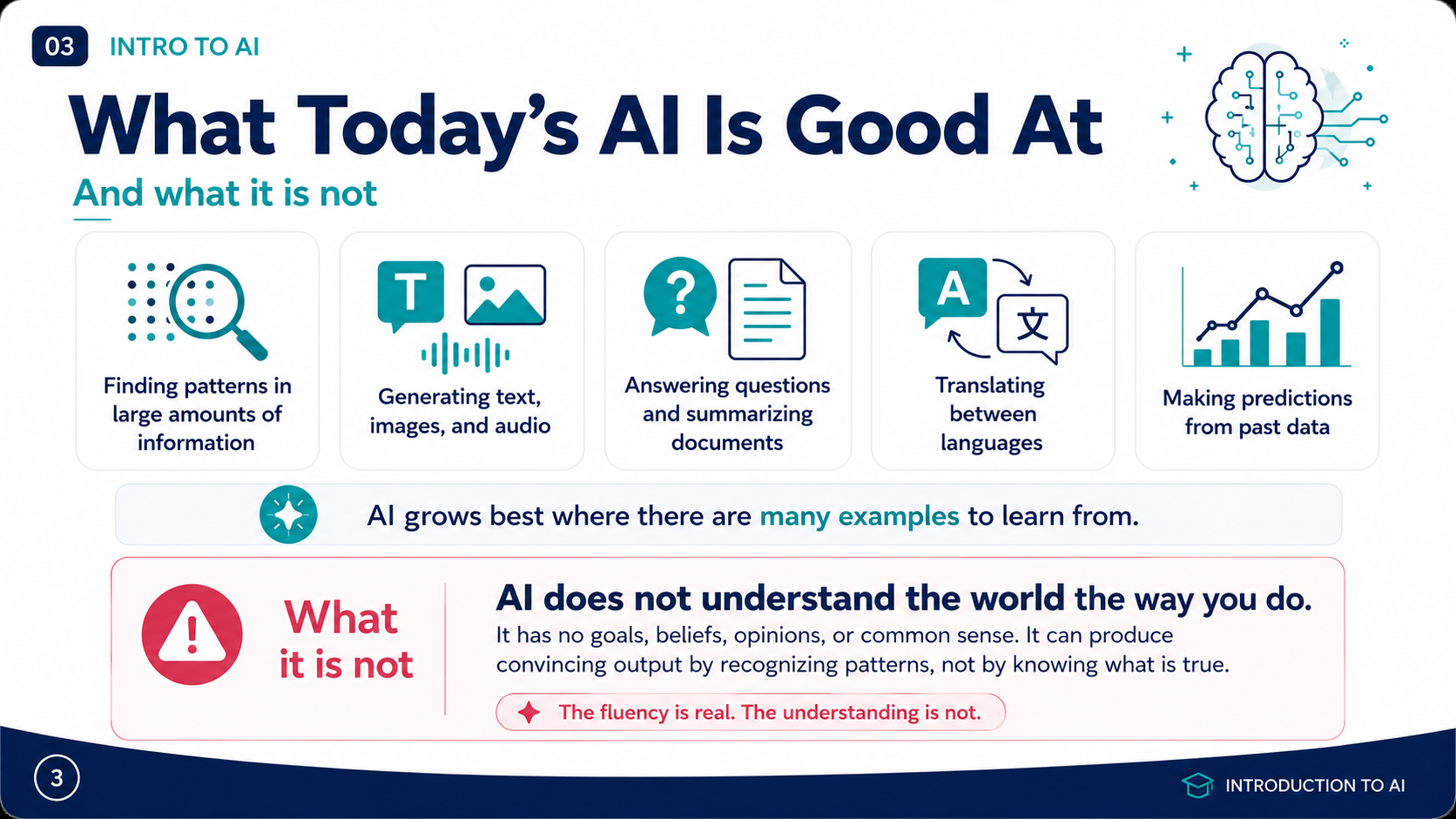
Narrow AI is narrow, but within its lanes it can be remarkable. The clearest way to see where it excels is to look for tasks that have two things in common: they involve recognizing patterns, and there are millions of examples to learn from.
- Finding patterns in large amounts of information: medical images, financial transactions, customer reviews, sensor readings
- Generating text, images, and audio that feel natural: drafts, summaries, translations, illustrations, voice responses
- Answering questions and synthesizing long documents into concise takeaways
- Translating between languages in real time, including spoken language
- Making predictions based on past data: which customers are likely to churn, which emails are spam, which parts are likely to fail
Notice the theme: every one of these is a task with lots of examples to learn from. That is the soil AI grows in. Where data is rich and structured, AI tends to perform well. Where data is scarce, ambiguous, or requires common-sense judgment about unusual situations, it tends to struggle.
What it is not
AI does not understand the world the way you do. It does not have goals, opinions, beliefs, or common sense. It produces convincing output by recognizing and reproducing patterns, not by knowing what is true.
Keep that distinction close, because it quietly explains almost everything that follows in this course. It is why AI can write a fluent paragraph about a historical event and get a key date wrong. It is why a customer-service bot can sound empathetic while having no concept of what a customer is actually going through. The fluency is real; the understanding is not.
This is not a criticism of the technology. A calculator is not criticizable for failing to appreciate the beauty of mathematics. But knowing the limits of a tool is the only way to use it safely and well.
A quick test you can use
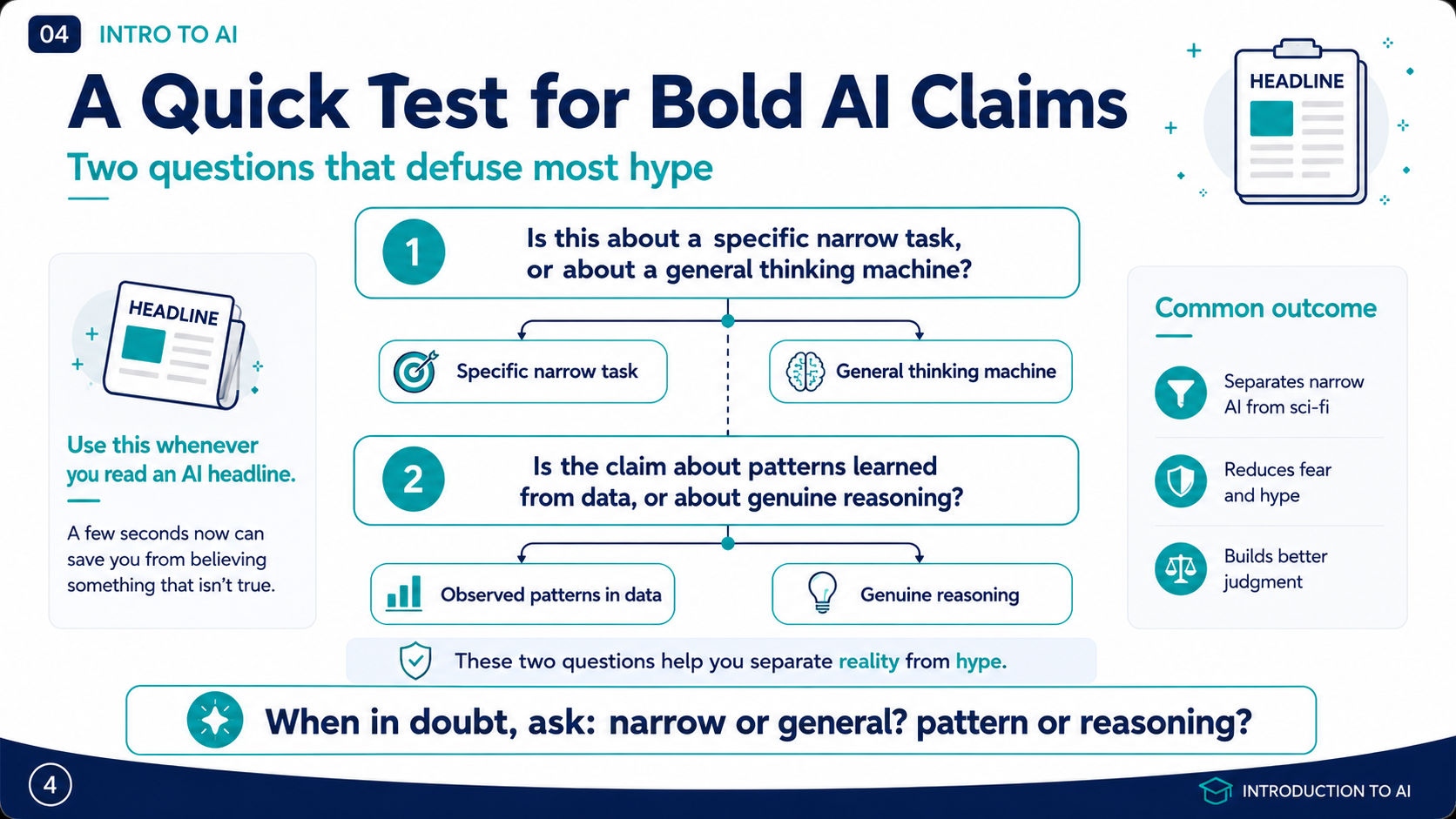
Whenever you read a bold claim about AI, ask two questions. First: is this about a specific, narrow task, or about a general thinking machine? Second: is the claim about something the system observed in its data, or about genuine reasoning and understanding?
Those two questions will defuse most of the breathless coverage you encounter. A system that can identify cancerous cells in biopsy images is doing something genuinely useful and impressive. It is not doing something that transfers to diagnosing a patient's mood or recommending a treatment plan based on their life circumstances. The narrow thing is real. The leap to the general thing is where the hype lives.
The vocabulary that actually matters
You will hear a lot of terms thrown around. Most of them are less important than understanding the core idea. But a handful come up so often that knowing them saves confusion:
- Model: the trained system you use. When someone says "the model got it wrong," they mean the AI software gave a bad answer.
- Prompt: what you type or say to the AI. Getting good at writing prompts is one of the most practical skills in this course.
- Output: what the AI produces in response. Text, an image, a prediction, a classification.
- Hallucination: when an AI produces a confident-sounding statement that is false. We will cover this in depth in lesson ten.
Why this matters for you
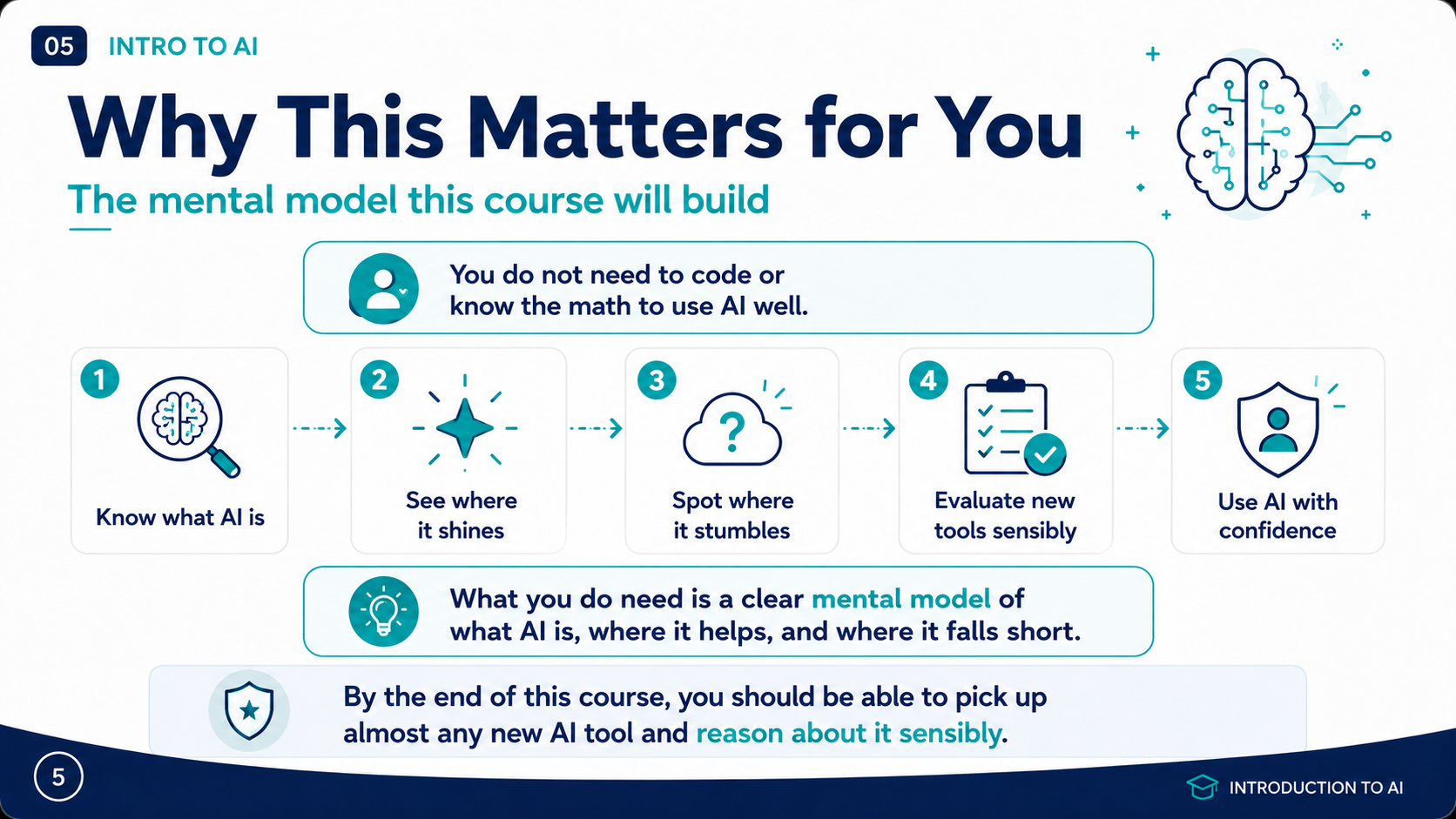
You do not need to write code or follow the mathematics to use AI well. You need a clear mental model of what it is, where it shines, and where it stumbles. That model is what the next eleven lessons will build, one comfortable step at a time.
By the end of this course you will be able to pick up almost any new AI tool and reason about it sensibly. You will know which claims to take seriously and which to set aside. You will have a vocabulary for discussing AI with colleagues and enough practical skill to start using it in your own work. None of that requires a technical background. It requires exactly what you are doing right now: paying careful attention.