
How Machines "Learn": A Plain-English Guide
Part 3 of 12 — Intro to AI for non-technical backgrounds
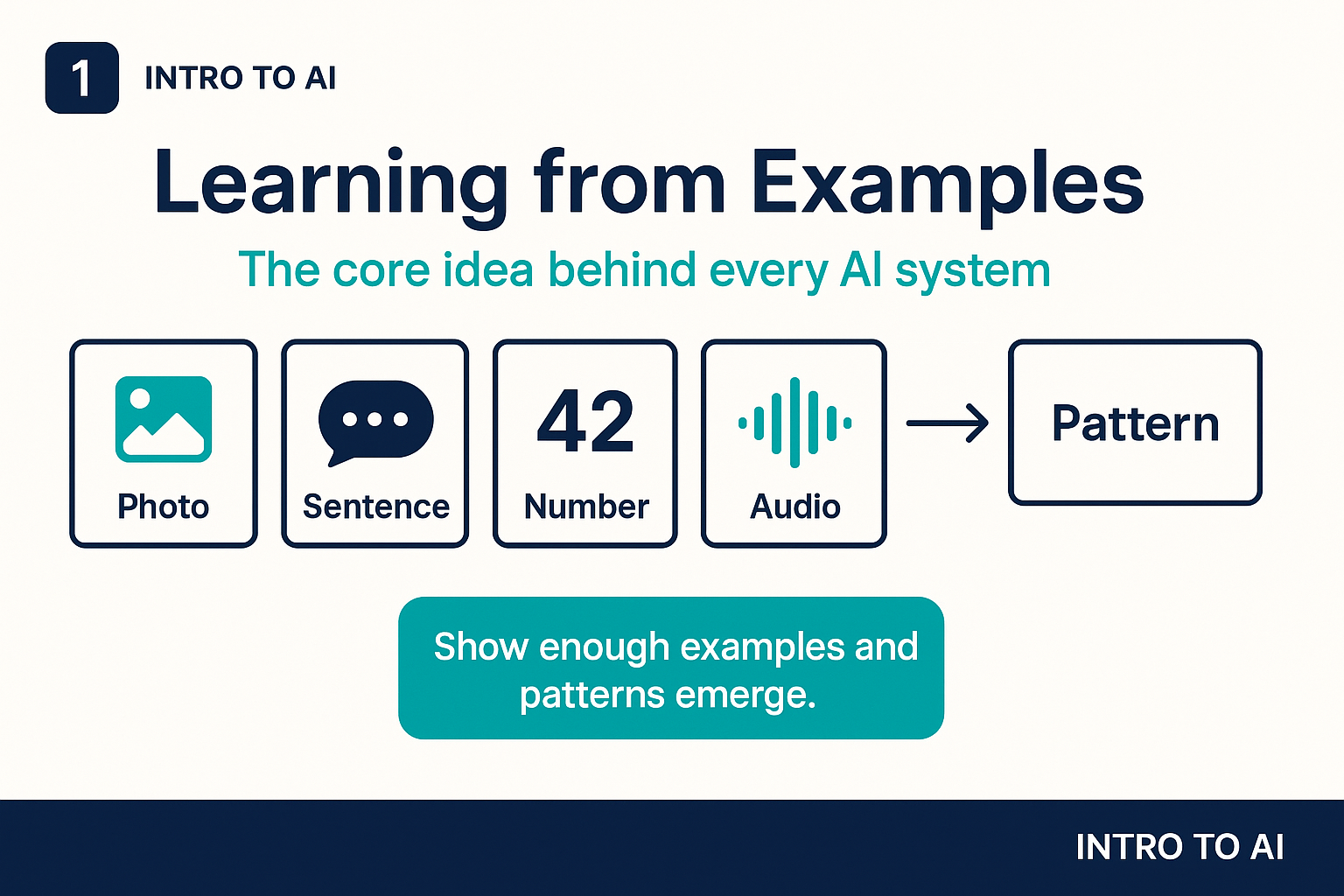
The phrase "machine learning" sounds technical, but the core idea is something you already understand from your own experience: we get better at things by seeing lots of examples. A child learns to recognize dogs not from a rulebook but from being shown many dogs and many not-dogs until the pattern clicks. Machine learning works exactly the same way, at enormous scale and speed.
Learning from examples
Imagine you are teaching someone to recognize fraudulent credit card transactions. You could try to write down every rule: "flag transactions over $500 at a foreign merchant between 2 and 4 in the morning." But fraudsters adapt. Your rules go stale. And the number of edge cases grows faster than you can write rules to handle them.
The machine learning approach is different. You gather hundreds of thousands of past transactions, each labeled "legitimate" or "fraudulent" by human investigators. You feed all of those examples to the software, which searches for patterns across them, gradually adjusting itself to get better at making the correct call. After enough examples and enough adjustment cycles, the system can spot suspicious patterns that no human rule-writer would ever have thought to specify.
This is the fundamental shift: from telling software what to look for, to showing it and letting it figure out the patterns itself.
The three ingredients
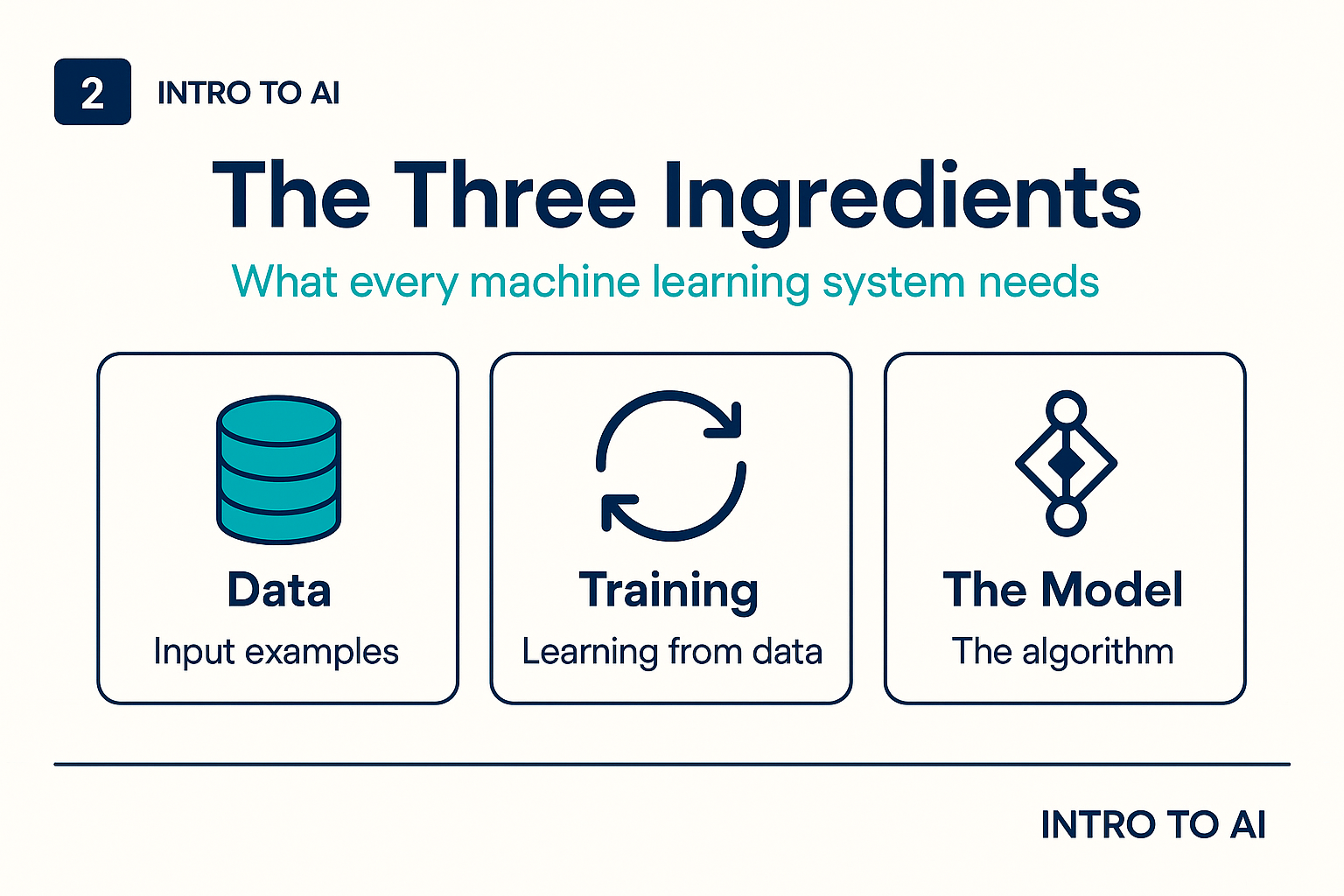
Every machine learning system, from a simple spam filter to a large language model, is built from the same three components:
- Data: the examples the system learns from. These can be photographs, sentences, numbers, audio clips, or any other information that can be represented digitally. The more varied and representative the examples, the better the system can learn to generalize.
- Training: the process of feeding those examples into the system and letting it adjust itself based on how well it does. Training can take minutes for a simple model or months for a large one.
- The model: the end result of training, a kind of compressed pattern-recognizing engine that you can now point at new information it has never seen before.
When someone says "we trained a model on customer reviews," they mean they showed software many thousands of customer reviews, each labeled with a sentiment or rating, until the software became reliably good at reading new reviews and judging how positive or negative they are. The model is what you use afterward. The training is how you got there.
How training actually works
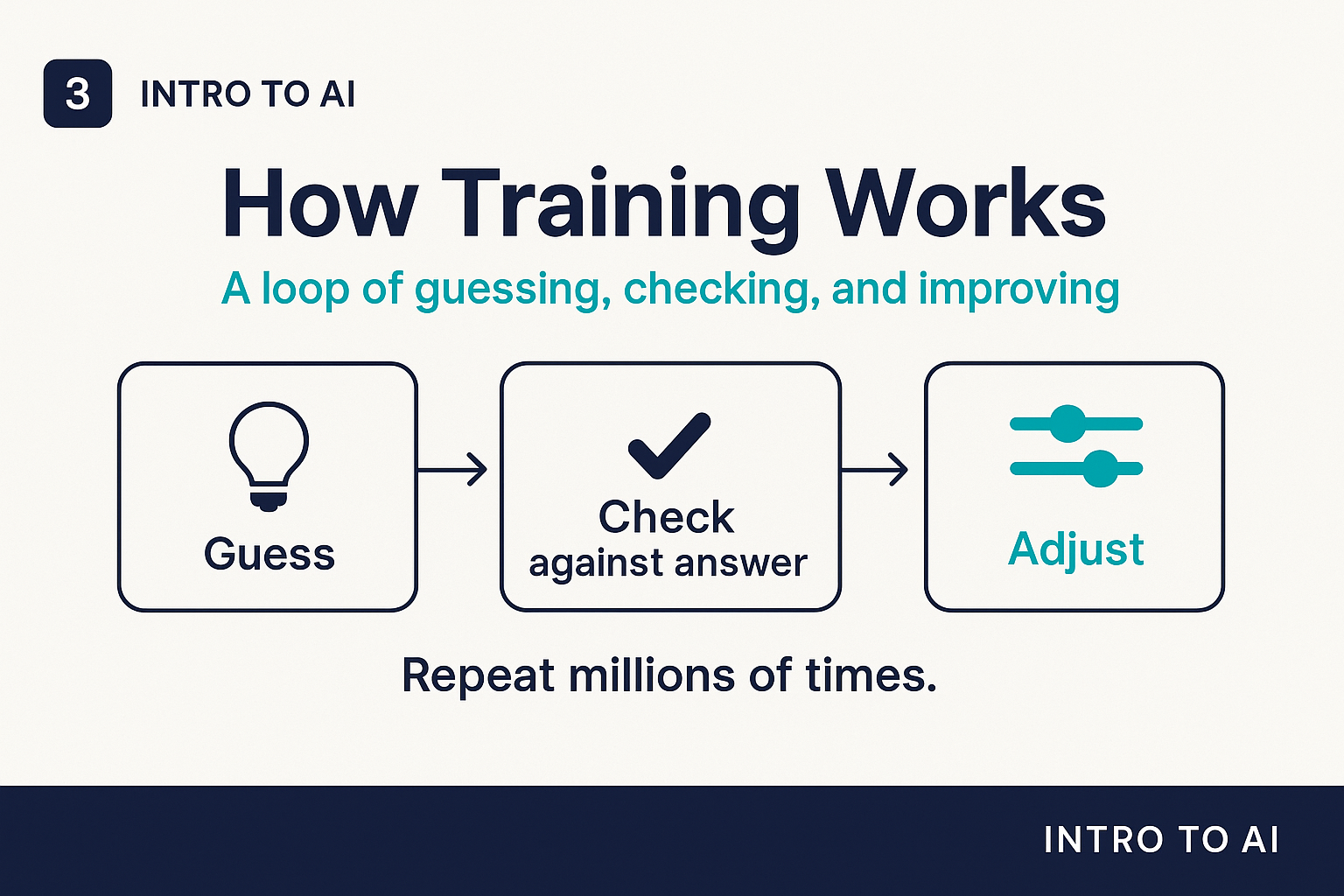
Training is a loop. The system makes a prediction on an example, compares its prediction to the correct answer, measures how wrong it was, and then makes a small adjustment to get slightly less wrong next time. This correction is tiny, almost imperceptible for any single example. But repeat the loop millions of times across millions of examples, and the small adjustments accumulate into genuine skill.
There is no understanding happening in a human sense. The system is not building a mental model of the world. It is doing something more like finding the shape of a landscape by taking countless small steps and noticing which direction goes uphill and which goes down. The technical term for this process is gradient descent, but you do not need to know the mathematics. What matters is the intuition: small corrections, repeated endlessly, produce a system that can do something surprisingly well.
Why data quality is everything
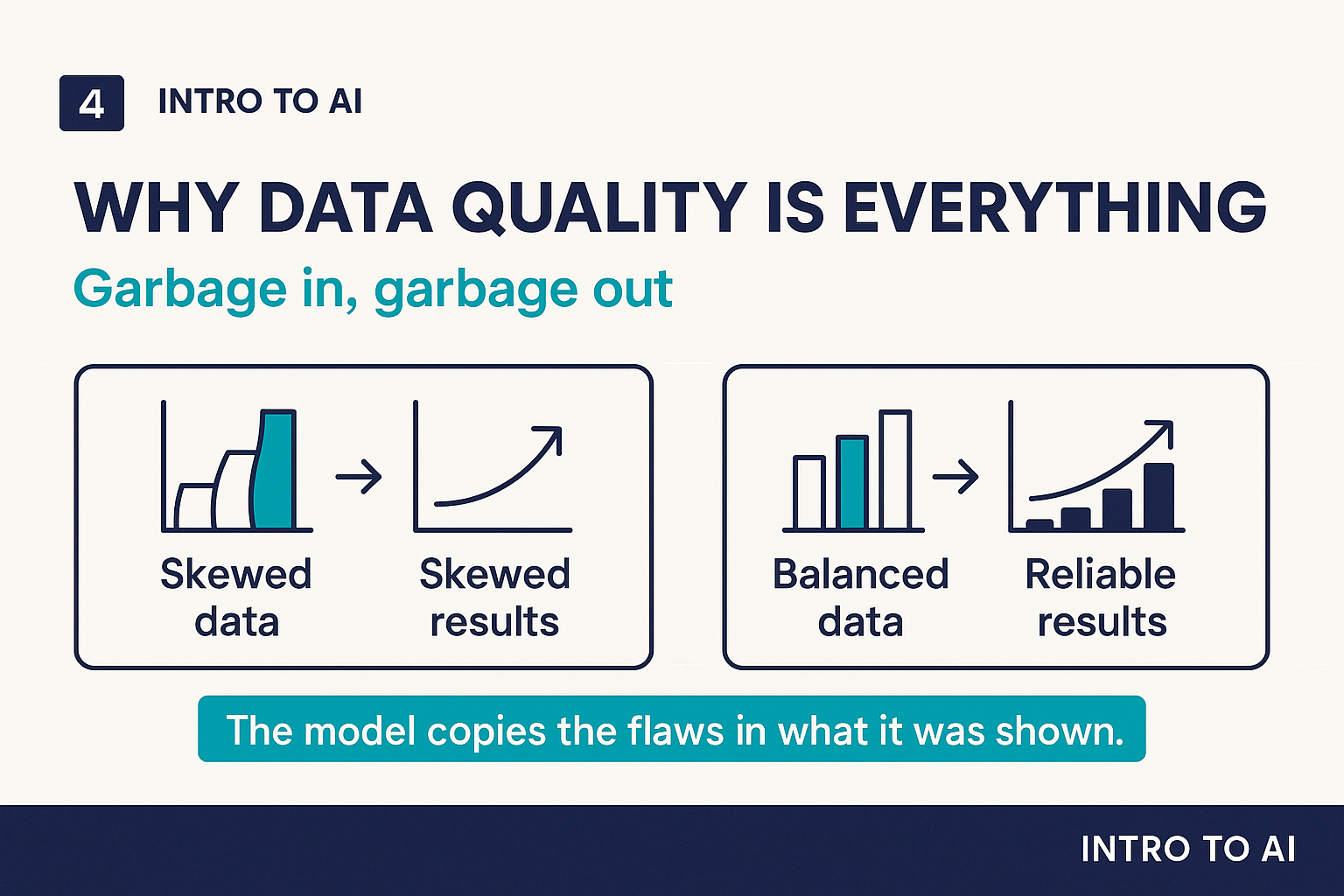
A model can only be as good as the examples it learned from. Feed it narrow, outdated, or skewed data, and it will faithfully produce narrow, outdated, or skewed results.
This is the most practically important fact about machine learning, and it is worth sitting with. A hiring tool trained mostly on resumes from one demographic will quietly favor that demographic, not because anyone programmed that preference in, but because the model is faithfully reflecting the patterns in what it was shown. A medical diagnosis system trained on data from one type of hospital may perform poorly at a different type of hospital with different patient populations.
Data quality problems include:
- Bias: some groups or cases are underrepresented in the training data
- Staleness: the training data was collected long ago and the world has changed
- Labeling errors: human annotators who labeled the training data made mistakes
- Distribution shift: the situations the model encounters in real life are different from what it was trained on
None of these are obscure edge cases. They show up constantly in real deployments, which is why AI systems need ongoing monitoring and human oversight, not just a one-time build and release.
Supervised versus unsupervised learning
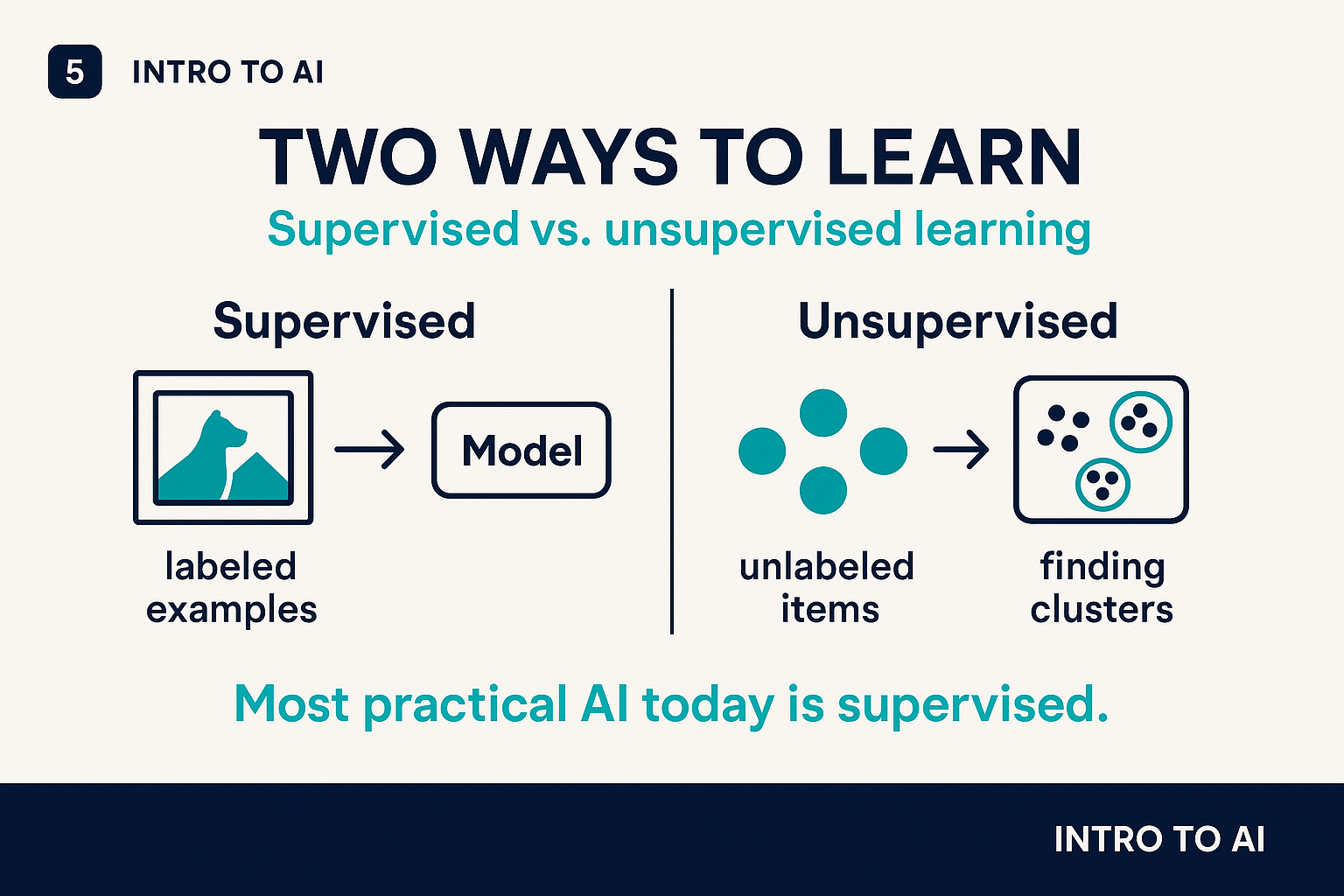
Most practical AI you will encounter uses supervised learning: every training example has a label telling the system what the right answer is. Photo plus label "cat." Email plus label "spam." Transaction plus label "fraudulent." The system learns to map inputs to the correct labeled outputs.
Unsupervised learning works without labels. You give the system unlabeled data and ask it to find patterns, groupings, or structure on its own. This is useful when you do not know in advance what categories exist. A retailer might use unsupervised learning to find natural clusters of customers in their purchase data, without knowing beforehand what those clusters would be.
There are other variations, like reinforcement learning (where a system learns by receiving rewards for good actions, like winning a game) and self-supervised learning (where the system creates its own labels from the data, which is how large language models are trained). But supervised learning is where most business applications live, and it is the clearest place to start building your intuition.
A quick vocabulary check
Before moving on, here are the core terms you will see again and again:
- Algorithm: the general recipe or procedure the computer follows while learning. Not the model itself, but the method used to train it.
- Training data: the labeled examples used to teach the model.
- Model: the finished, trained system you actually use afterward.
- Inference: using a trained model on new data. When you type a question into a chatbot and get a response, that is inference.
- Parameters: the internal numbers the model adjusts during training. Large models have billions of these. You never see them directly, but they encode everything the model has learned.
That is the foundation. Everything in modern AI, including the headline-grabbing tools you use every day, is built on this one idea: learn the patterns from examples, then apply them to something new.