
Machine Learning, Deep Learning, and Neural Networks
Part 4 of 12 — Intro to AI for non-technical backgrounds
You have probably seen the terms machine learning, deep learning, and neural networks used interchangeably in headlines and conversations. They are related but not the same thing. Understanding how they fit together gives you a map for almost every AI system you will encounter, from a simple recommendation engine to a large language model.
Machine learning: the umbrella
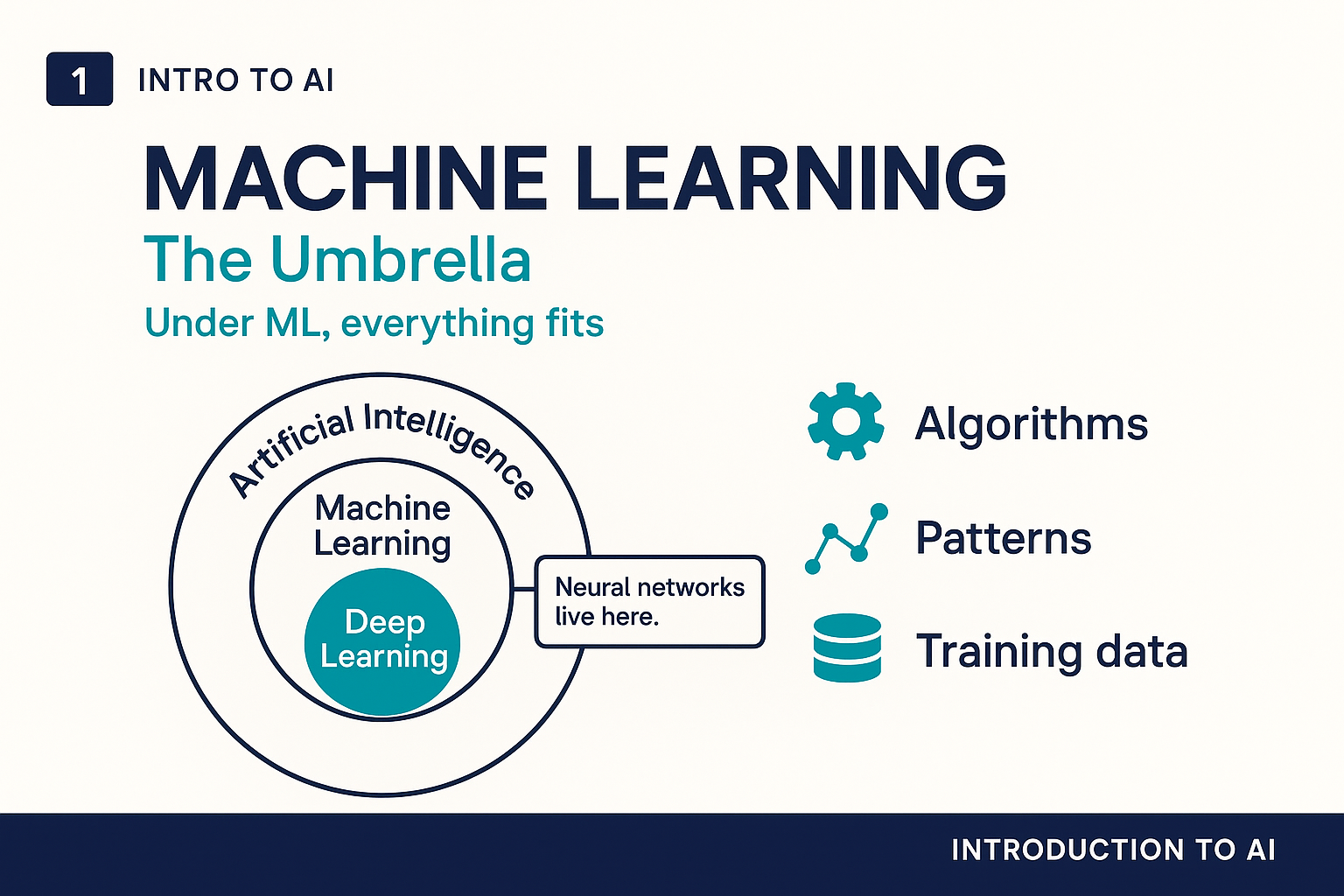
Machine learning is the broadest of the three terms. It describes any approach where software improves its performance by learning from data, rather than following hand-written rules. Under this umbrella you will find dozens of different techniques, from simple methods like linear regression that a statistician from the 1950s would recognize, to the deep learning systems that power today's most capable AI.
Not every machine learning system is a neural network. Many highly effective models in healthcare, finance, and logistics use techniques like decision trees, random forests, or gradient boosting, none of which resemble brains in any meaningful way. The right tool depends on the problem, the data available, and the constraints you are working under.
What a neural network actually is
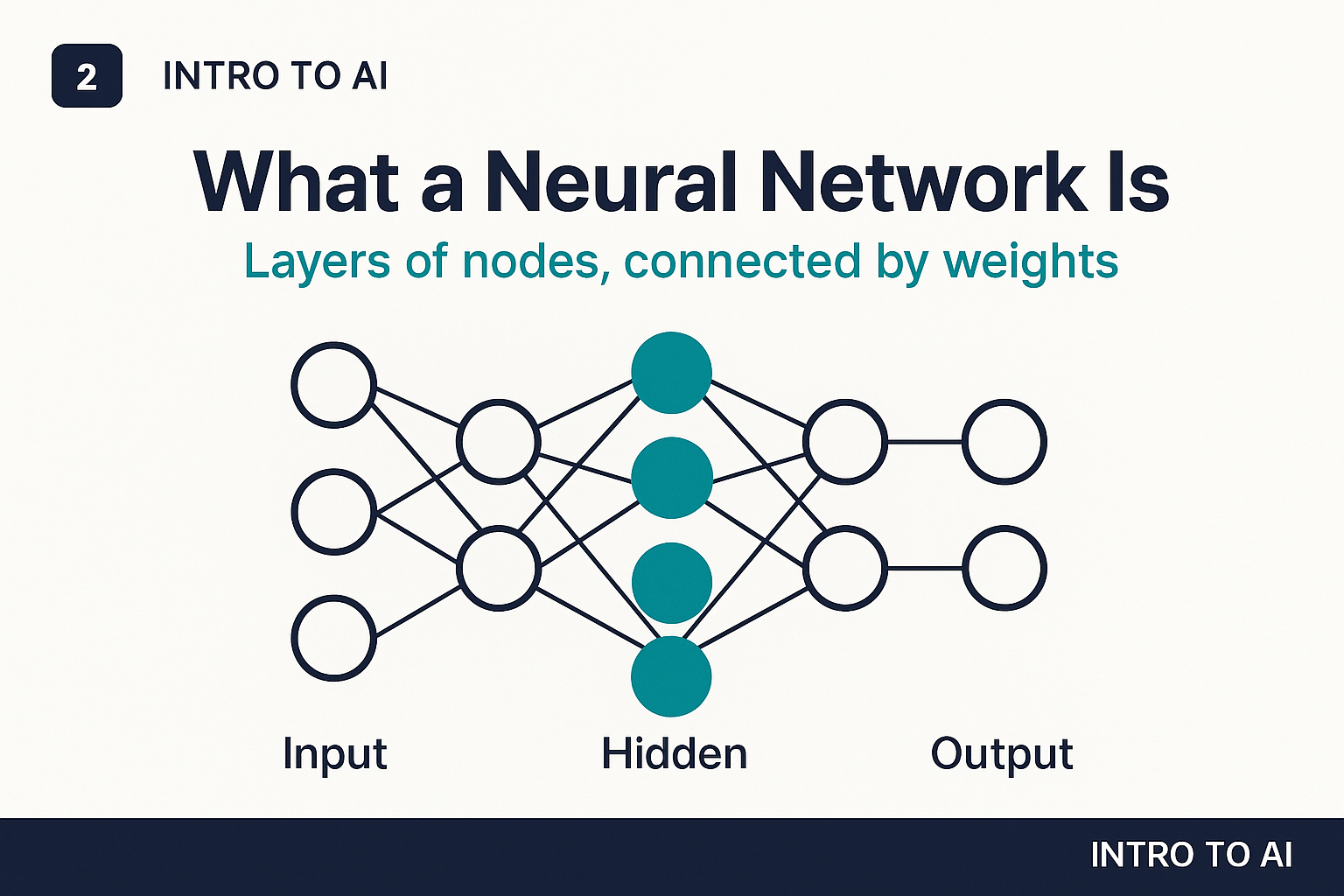
A neural network is loosely inspired by the structure of a biological brain, though the resemblance is more metaphorical than literal. It consists of layers of simple mathematical units called nodes or neurons. Each node takes in some numbers, does a small calculation, and passes its output to the next layer.
The network has three basic types of layers:
- Input layer: receives the raw data. For an image, each pixel's value might be one input node.
- Hidden layers: intermediate layers that transform the data, extracting progressively more abstract features. Early layers might detect edges. Middle layers might detect shapes. Later layers might detect objects.
- Output layer: produces the final result. For an image classifier, this might be a probability for each possible label: 90% cat, 8% dog, 2% other.
The connections between nodes have numerical weights, and training adjusts those weights until the network gives good answers. A small network might have thousands of weights. A large language model has hundreds of billions.
Why "deep" changed everything
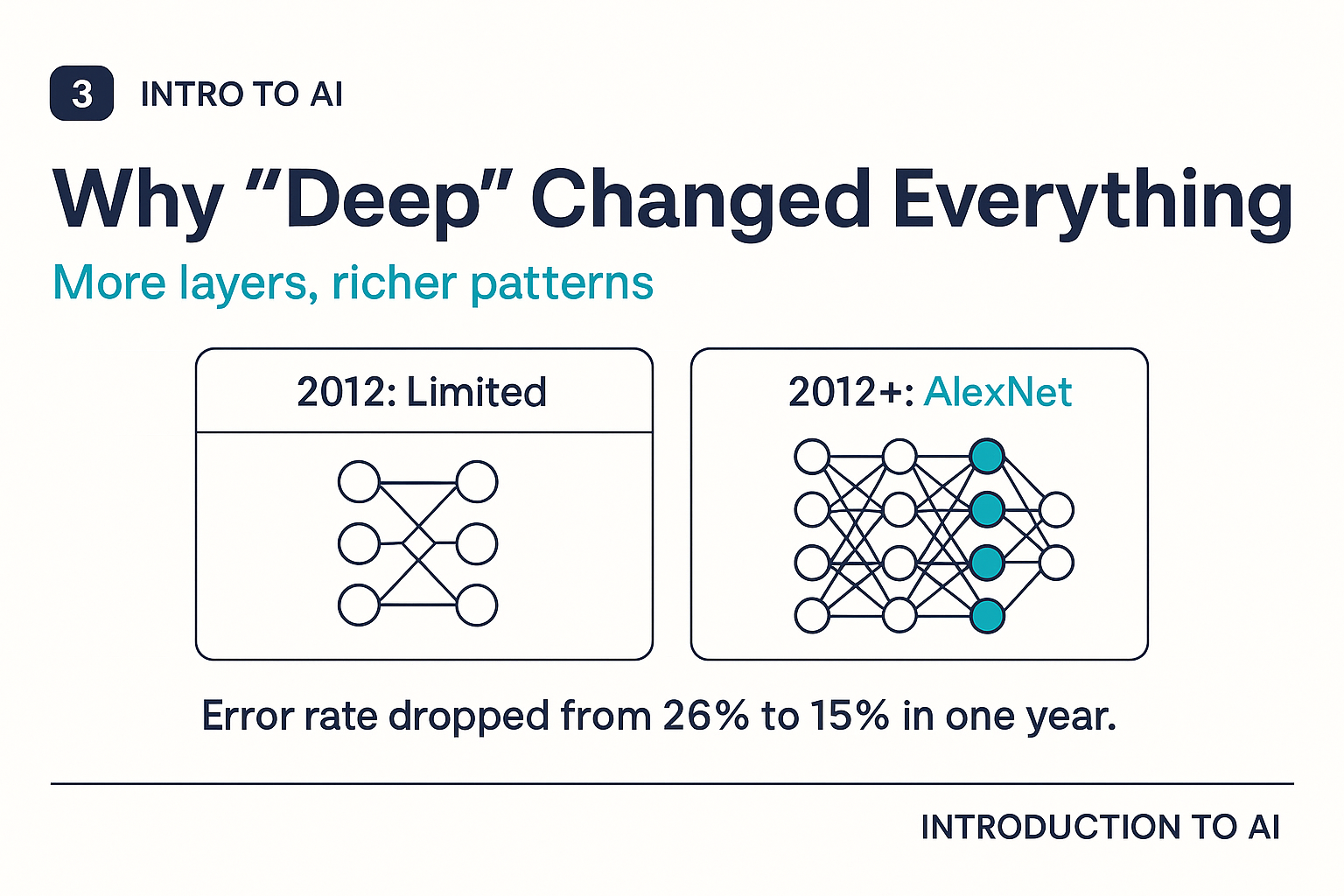
A "deep" neural network simply has many hidden layers, sometimes dozens or hundreds. Depth matters because each layer can learn to represent the data at a higher level of abstraction. A shallow network might learn to detect basic image features. A deep network can build those features into complex, hierarchical representations that capture far more of what makes a cat a cat, regardless of lighting, angle, or breed.
Deep learning had been theorized for decades, but it could not be made practical until three things converged: enough labeled data to train on, enough computing power to run the optimization, and architectural improvements that made deep networks easier to train. The 2012 ImageNet competition made the convergence visible. A deep network called AlexNet reduced the image classification error rate from 26% to 15% in a single competition cycle. The field never went back.
The transformer: the architecture behind the AI you use today
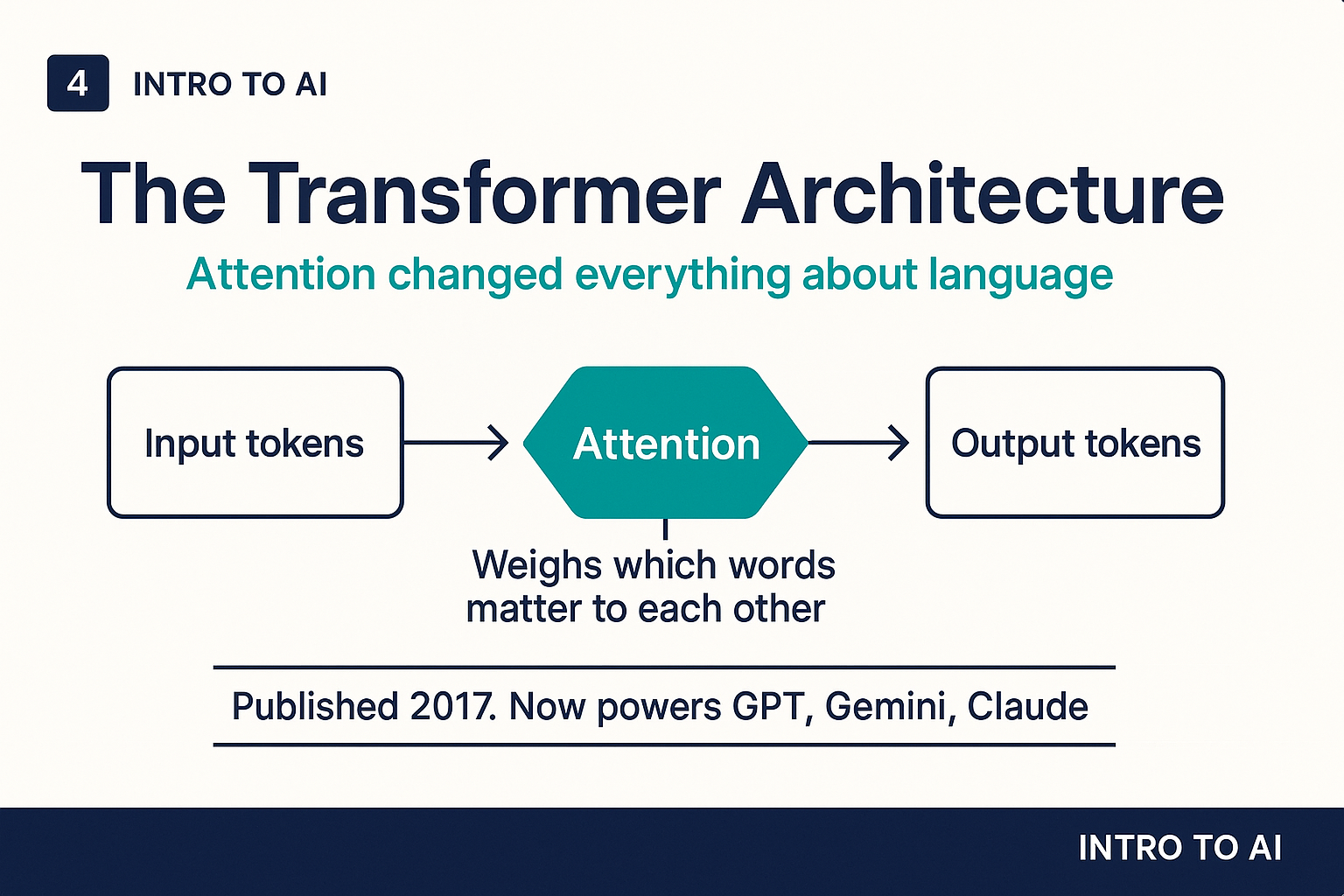
In 2017, researchers at Google published a paper titled "Attention Is All You Need." It introduced a new architecture called the transformer, which proved to be extraordinarily powerful for processing language. The key innovation was the attention mechanism: a way for each word in a sentence to weigh the relevance of every other word when deciding what it means. "Bank" means something different in "river bank" than in "bank account," and attention lets the model figure that out from context.
Transformers scaled remarkably well. As researchers made them larger and trained them on more data, performance kept improving in ways that earlier architectures had not. Large language models like GPT, Claude, and Gemini are all transformers. So are the image generation models and the voice recognition systems you use on your phone. The transformer is the engine under the hood of most modern AI.
What this means for you
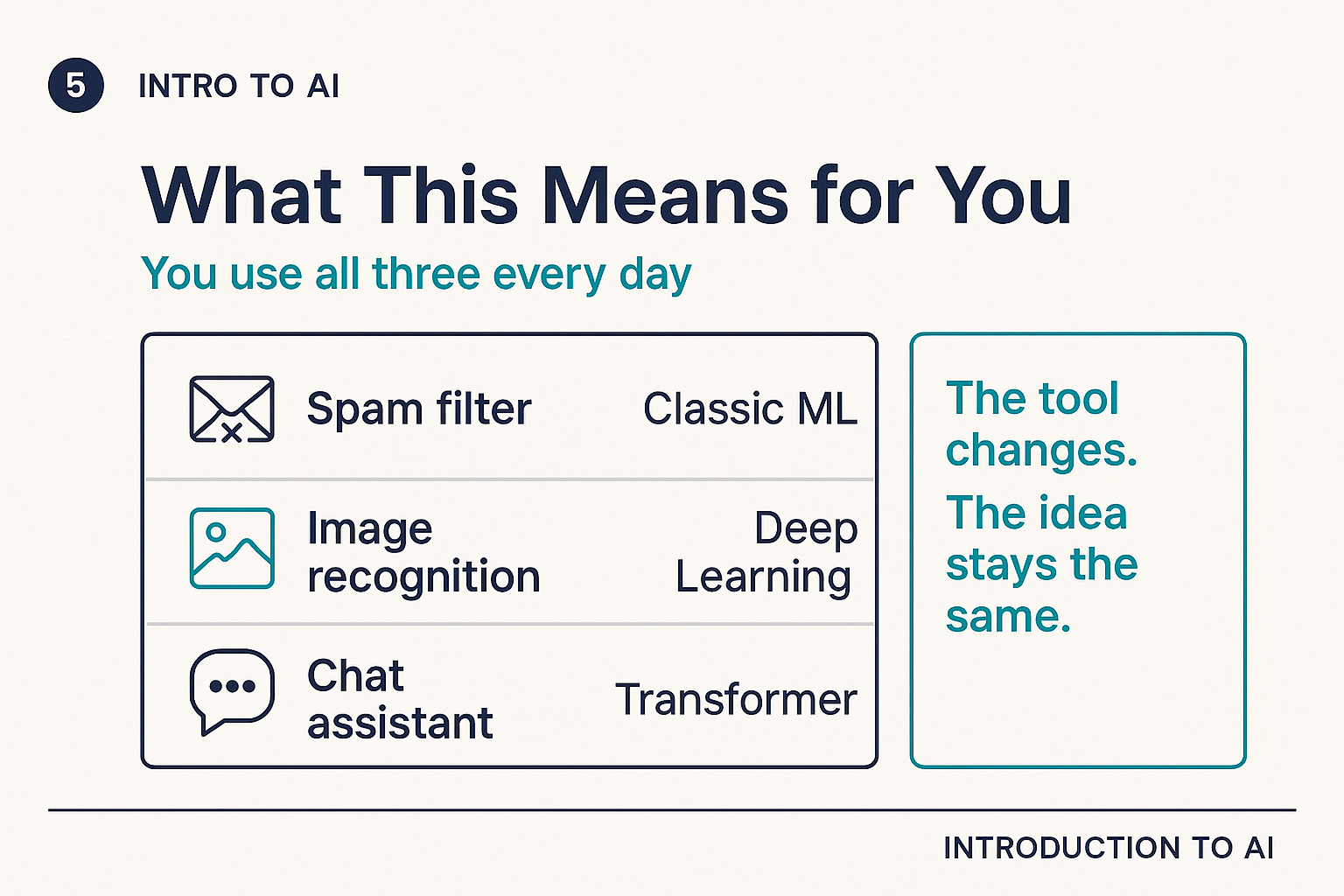
You do not need to understand the mathematics of any of this to use these systems well. But the conceptual map is useful. When you use a chatbot, you are using a transformer-based large language model. When a photo app automatically organizes your pictures by face or location, that is a convolutional neural network, a type of deep learning architecture specialized for images. When Netflix recommends a show, that is often a different type of model entirely, one built for collaborative filtering across millions of users.
The tool changes. The underlying idea stays the same: a system trained on examples, with the right architecture for the task, can recognize patterns in new data at a speed and scale no human team could match.
A practical summary
- Machine learning is the broad field of teaching software to learn from data.
- Neural networks are a family of models inspired loosely by the brain, with layers of connected nodes.
- Deep learning is the use of neural networks with many layers, which proved dramatically more powerful than shallower approaches.
- Transformers are the specific deep learning architecture that now powers most of the AI tools you interact with daily.
Each one contains the next, like nesting dolls. Machine learning contains deep learning, which contains the transformer. Most of what you read about in AI today lives in the innermost doll.