Talking to AI: The Art of Prompting
Part 6 of 12 — Intro to AI for non-technical backgrounds
The same AI model can produce a vague, unhelpful response or a precise, genuinely useful one, depending almost entirely on how you ask. This is not a quirk or a bug. It is the nature of the technology. Large language models are trained to produce plausible continuations of text. The clearer and more specific your input, the clearer and more specific the output. Learning to write good prompts is the single highest-return skill for anyone using AI tools.
Why prompting matters more than you might expect
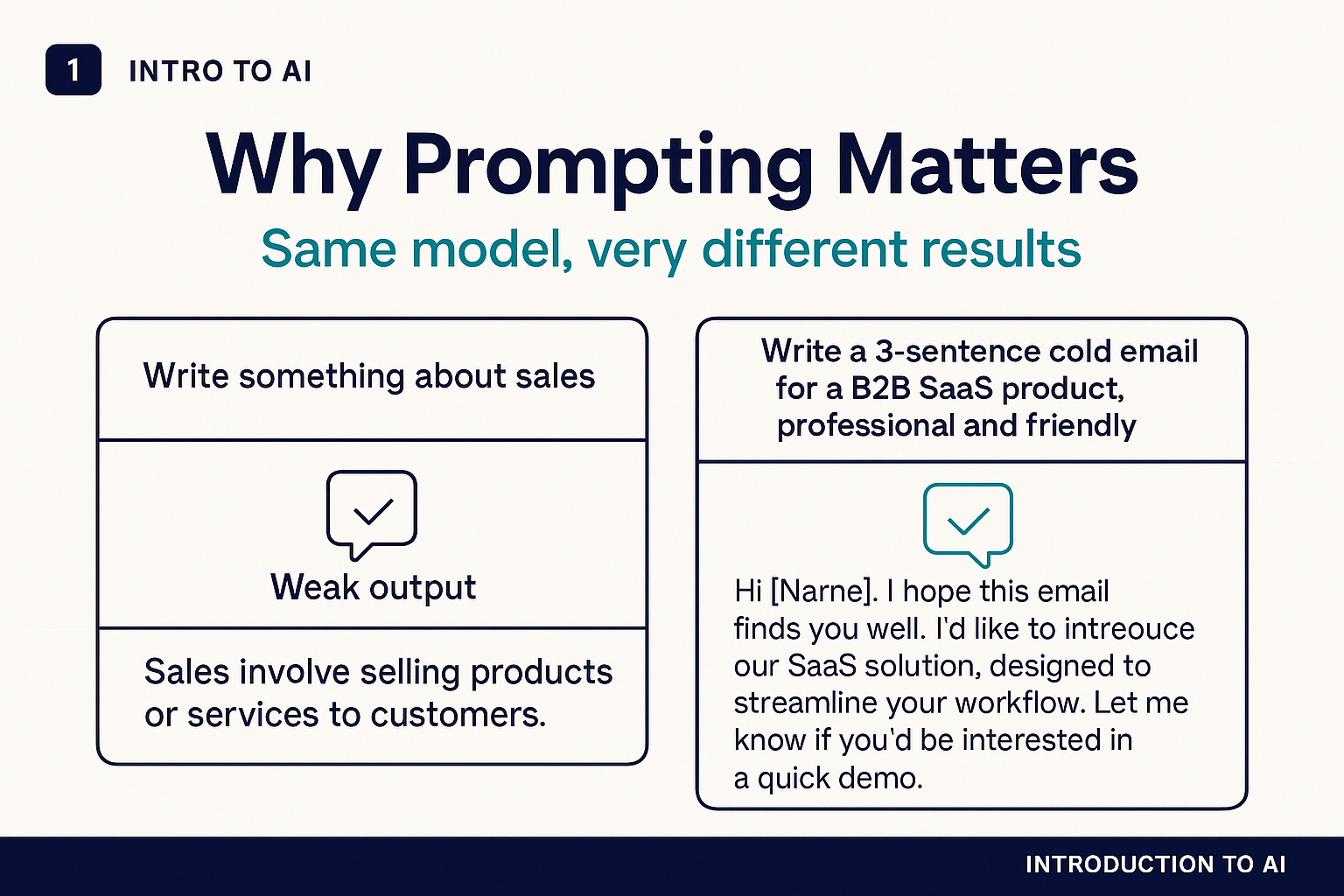
Imagine asking a highly capable but literal-minded assistant to "write something about sales." You might get a philosophical paragraph about the history of commerce, or a children's story featuring a lemonade stand. Both are technically responsive. Neither is what you needed. Now imagine asking: "Write a 200-word cold outreach email for a B2B software product aimed at HR directors in mid-size companies. Professional but conversational tone. Lead with the problem we solve, not with our product features." You will get something usable almost immediately.
The difference is not the intelligence of the model. It is the specificity of the request. AI does not read minds. It responds to what it receives.
The anatomy of a good prompt
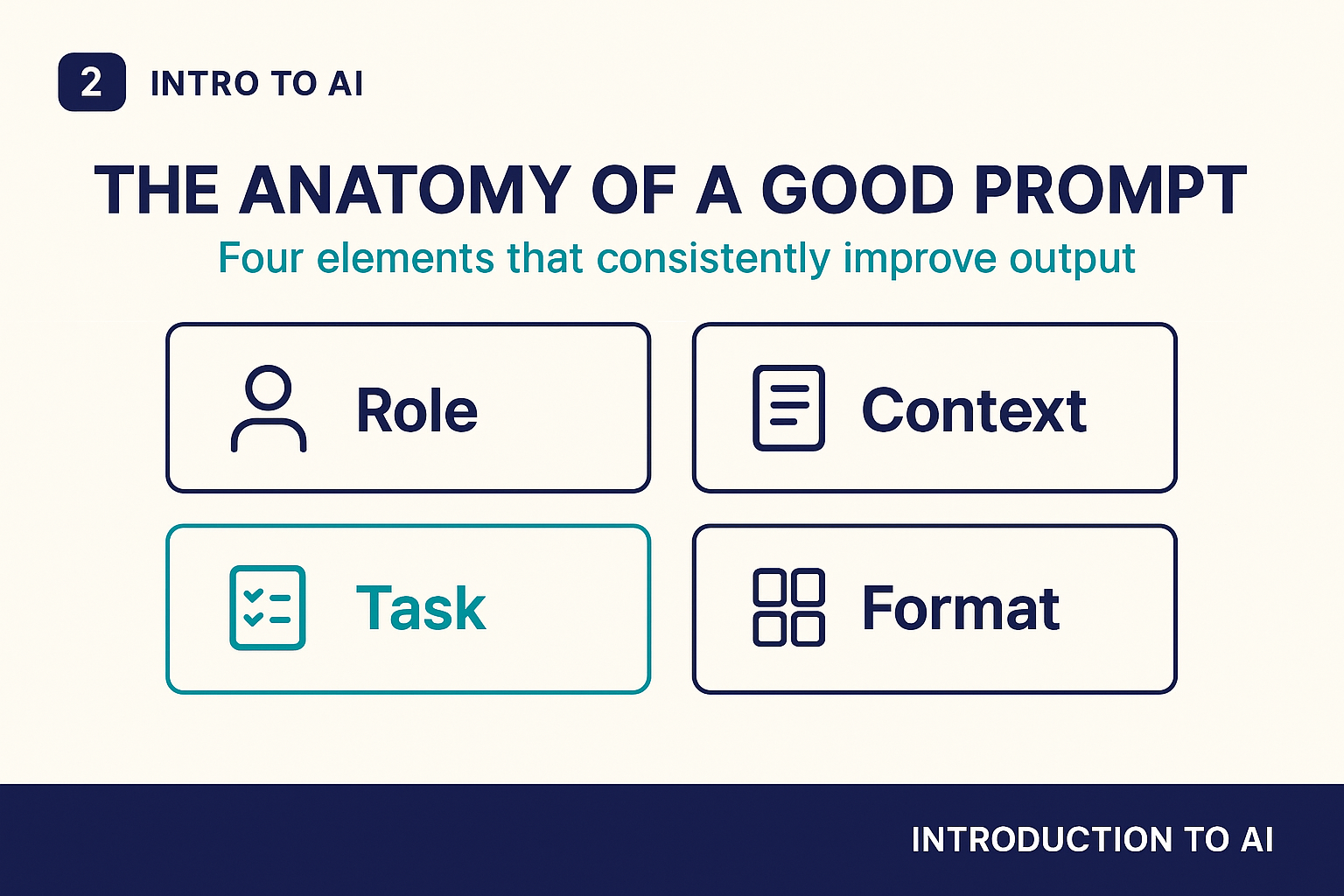
Strong prompts tend to include four elements. You do not always need all four, but knowing what they are helps you diagnose why a prompt is not working.
- Role: who or what should the AI be for this task? "You are an experienced marketing copywriter with a background in fintech." Giving the model a role helps it tune its vocabulary, tone, and assumptions to match.
- Context: what does the model need to know to answer well? Background on your company, your audience, the document you are working from, or the constraints you are working within.
- Task: what exactly do you want? This should be the most specific part. Vague tasks produce vague responses. "Summarize this" is weaker than "Summarize this in three bullet points, each under 20 words, for an executive audience with no technical background."
- Format: how do you want the output structured? A bulleted list, a table, a paragraph, a numbered sequence, a specific word count. If format matters to you, specify it.
Prompt patterns that consistently work
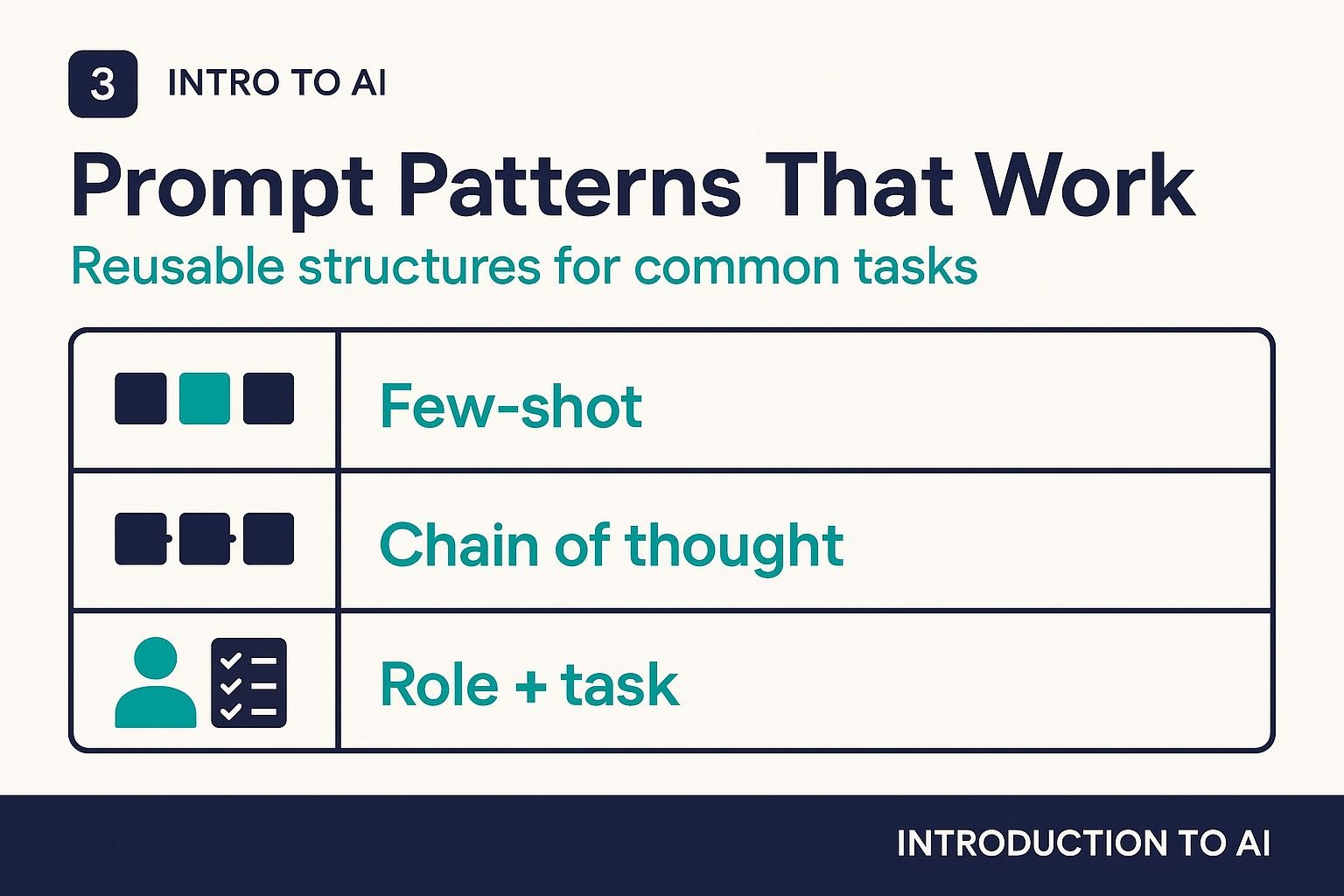
Researchers and practitioners have identified several prompt patterns that produce reliably better results across a wide range of tasks:
- Few-shot prompting: provide two or three examples of the input-output pair you want before asking for a new one. The model picks up the pattern and applies it. "Here are two examples of the kind of response I want: [example 1] [example 2]. Now do the same for: [your actual input]."
- Chain of thought: ask the model to think step by step before giving its final answer. "Before answering, reason through the problem one step at a time." This dramatically improves performance on tasks involving logic, math, or multi-step reasoning.
- Role plus task: combine a clear persona with a specific job. "You are a skeptical editor at a business magazine. Review this draft for unsupported claims and suggest where I need more evidence." The persona sharpens the model's judgment.
- Constraint-first prompting: lead with what not to do before describing what to do. "Do not use jargon. Do not start with the word I. Do not exceed 150 words. Now write a brief LinkedIn post about..."
Iteration is the skill
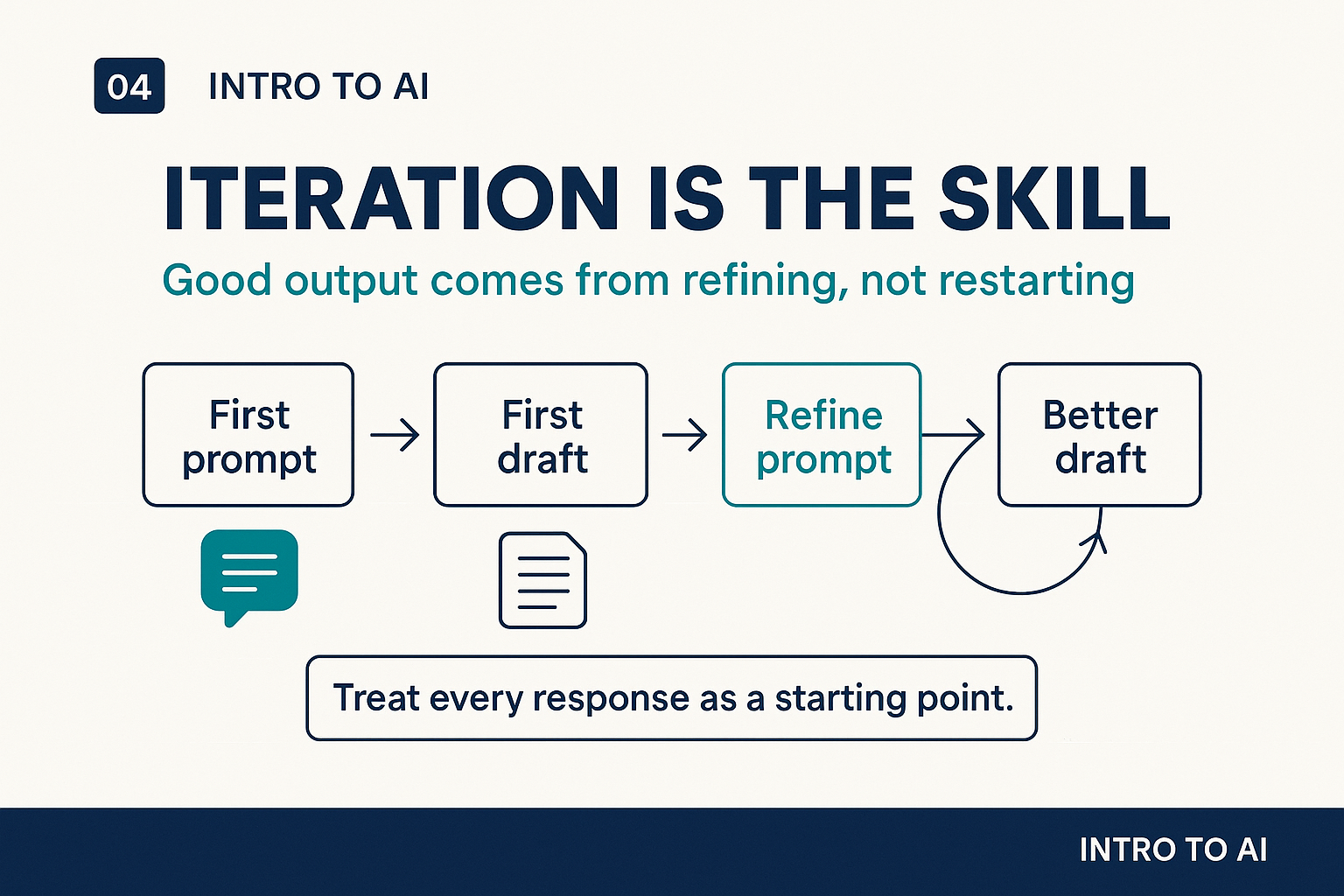
The biggest mistake new users make is treating the first response as the final answer. The first response is a starting point. The real skill is in what comes next: reading the output critically, identifying what is close but not quite right, and refining your prompt to get closer.
You can say things like: "Good start, but the tone is too formal. Rewrite the second paragraph to be more direct and use simpler vocabulary." Or: "The structure works but I need the recommendations section to come before the background section, and each recommendation should include a one-sentence rationale." These follow-up prompts are just as important as the first one, and with practice they become natural.
Think of a prompt conversation as iterative editing, not a one-shot question. You are collaborating with a very fast, very literal first drafter.
What to avoid
Several common prompting mistakes make results consistently worse:
- Asking for too many things at once. "Write me a proposal, suggest a budget, create a timeline, and draft three email subject lines" in a single prompt tends to produce shallow work on all four. Break complex requests into separate prompts.
- Being vague about audience. The appropriate vocabulary, depth, and tone are entirely different for a CEO, a software engineer, and a high school student. Specify who the output is for.
- Skipping constraints. If length, format, or style matter, say so up front. It is much harder to ask the model to shrink a 500-word response than to ask for 200 words from the start.
- Assuming facts in the prompt are verified. The model will usually accept your framing. If your prompt contains a factual error, the response will often compound it.
Building your own prompt library
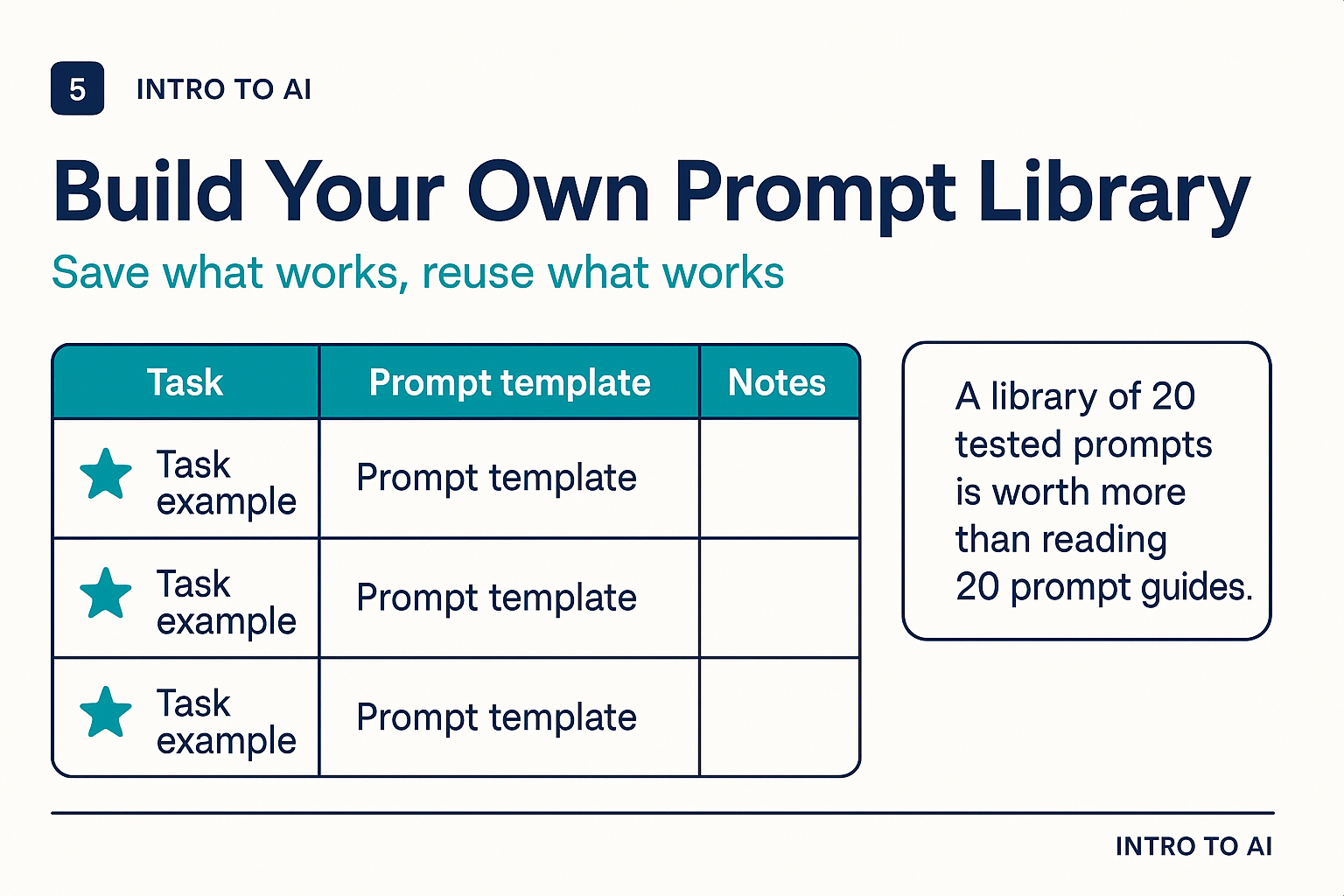
Once you find a prompt structure that works well for a recurring task, save it. A personal prompt library is a collection of tested, reliable templates for the things you do most often: summarizing meeting notes, drafting client emails, generating report outlines, reviewing documents for a specific type of issue. Over time, a library of twenty or thirty well-tested prompts will save you hours every week and produce more consistent results than starting from scratch each time.
You can store these in a simple document, a note-taking app, or a spreadsheet. Include the template, the task it solves, and any notes about what variations work well. Treat it as a living document you refine as you learn.