The Generative AI Revolution
Part 5 of 12 — Intro to AI for non-technical backgrounds
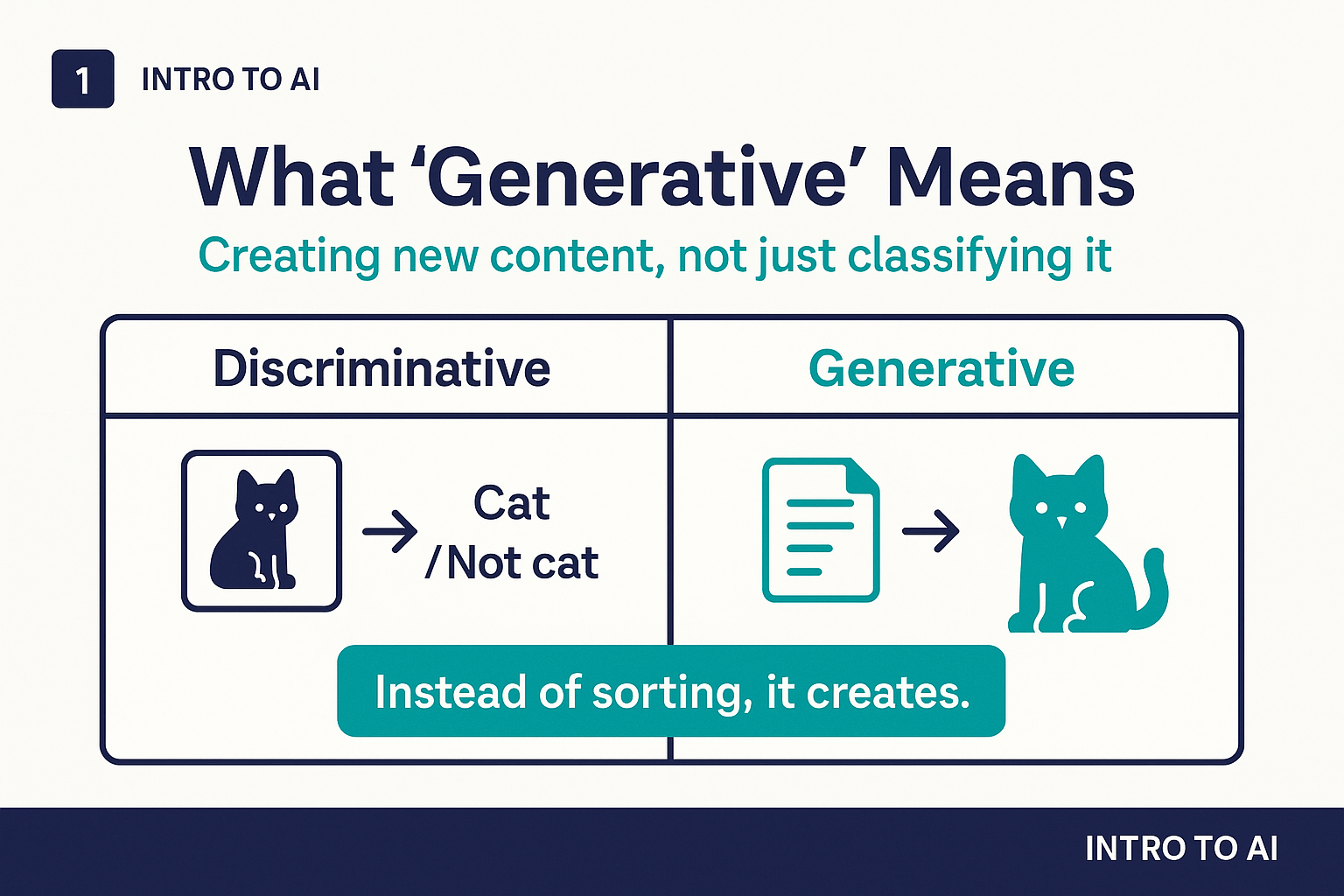
For most of AI's history, the most impressive systems were built to classify, predict, or rank: is this image a cat or a dog? Will this customer churn? Which search result is most relevant? These are all forms of discriminative AI. They draw boundaries between categories. The revolution of the last few years has been the rise of a different kind: generative AI, which creates new content rather than sorting existing content.
What "generative" actually means
A discriminative system takes input and outputs a label or a prediction. A generative system takes input and outputs new content: text, images, audio, video, code. The distinction sounds simple but it changes everything about what the technology can do. A classifier tells you whether an email is spam. A generative system can write you a new email from scratch.
Generative AI is not new in principle. Researchers have been working on it for decades. What changed in the last few years is scale: the models became large enough, and were trained on enough data, to produce output that feels genuinely creative, coherent, and useful rather than mechanical and obviously synthetic.
How large language models work
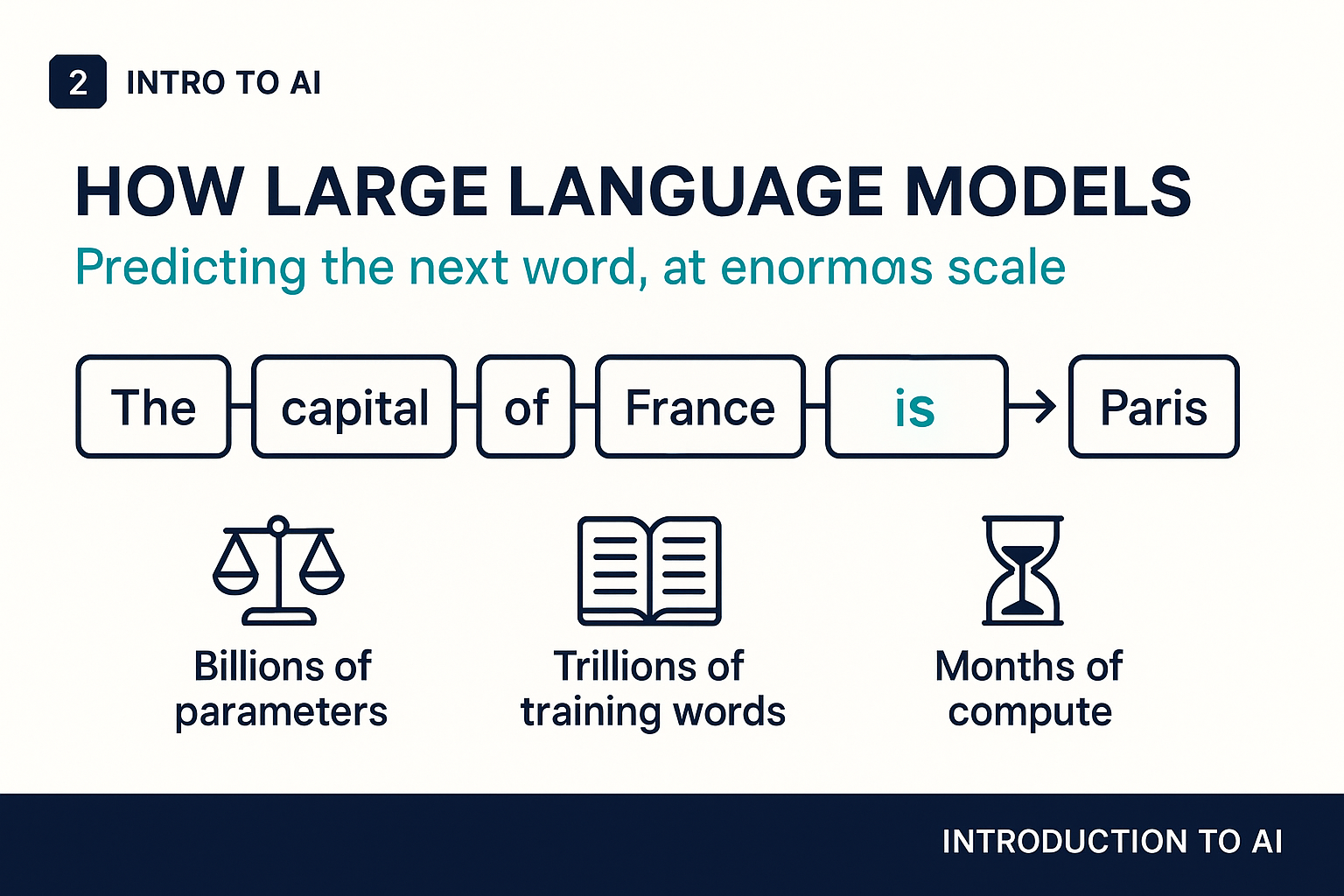
Large language models, the technology behind chatbots like ChatGPT, Claude, and Gemini, are trained on an enormous amount of text: web pages, books, articles, code, conversations. The training task is deceptively simple: predict the next word, given all the words that came before it. Do this billions of times across trillions of words, and the model learns far more than just word sequences. It absorbs grammar, facts, reasoning patterns, writing styles, and a surprising amount of world knowledge, all as a side effect of getting good at the next-word prediction task.
At inference time, when you type a prompt and wait for a response, the model generates one word at a time. Each word is chosen based on probability: given everything in the conversation so far, what word most plausibly comes next? Repeat that process until you have a complete response. The result can look like fluent reasoning, but underneath it is sophisticated pattern completion at scale.
How AI generates images
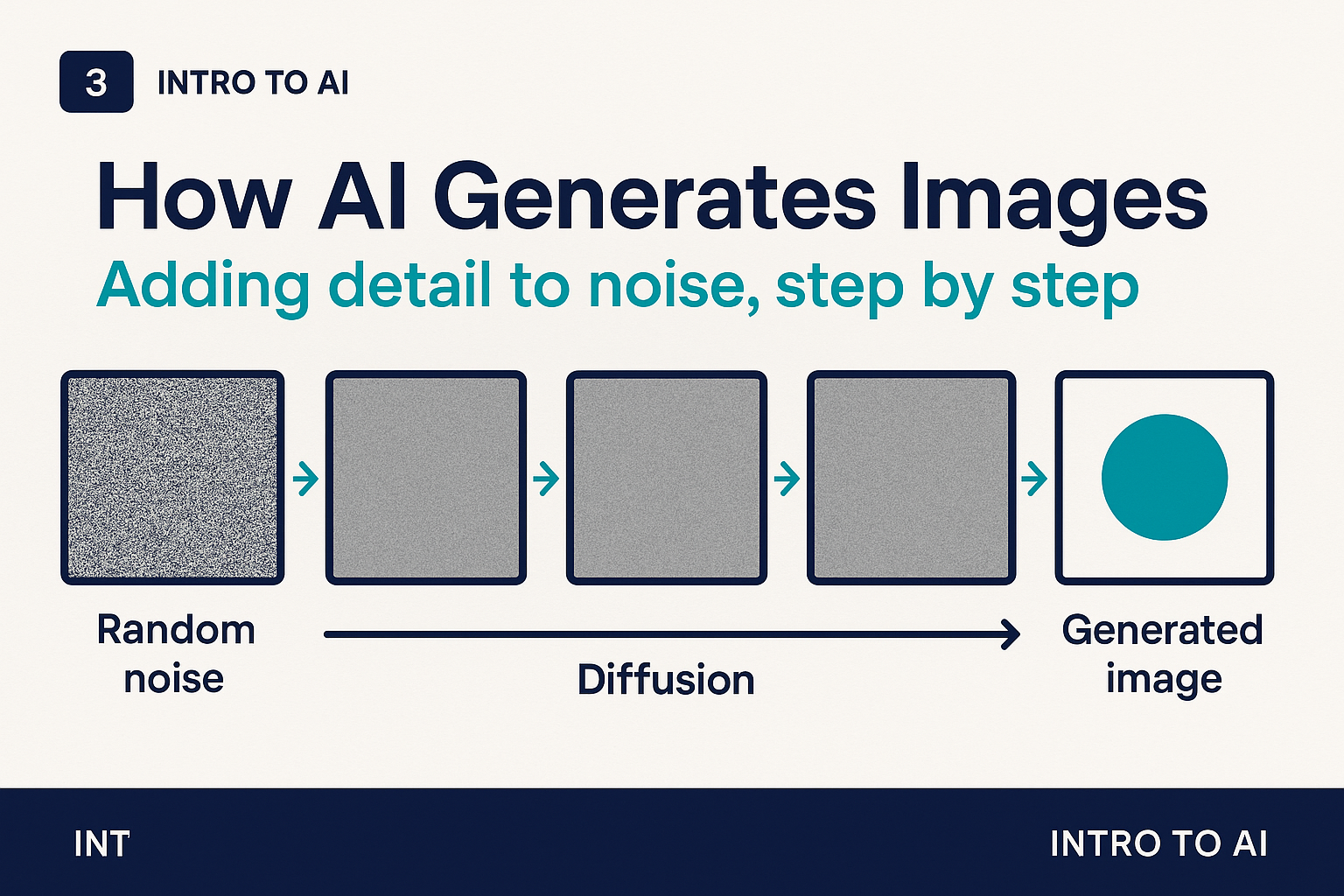
Image generation works differently from language models. The dominant approach today is called diffusion. The model learns by studying millions of images and their captions. During training, it repeatedly adds random noise to images until they become unrecognizable, and then learns to reverse that process: starting from pure noise, it gradually removes it to recover a recognizable image.
At generation time, you give the model a text description. It starts from a field of random noise and, guided by your description and everything it learned during training, iteratively refines that noise into an image that matches your prompt. The result can be photorealistic, painterly, abstract, or anything in between, depending on how you describe it. Systems like DALL-E, Midjourney, and Stable Diffusion all work on variations of this principle.
Voice, audio, and multimodal systems
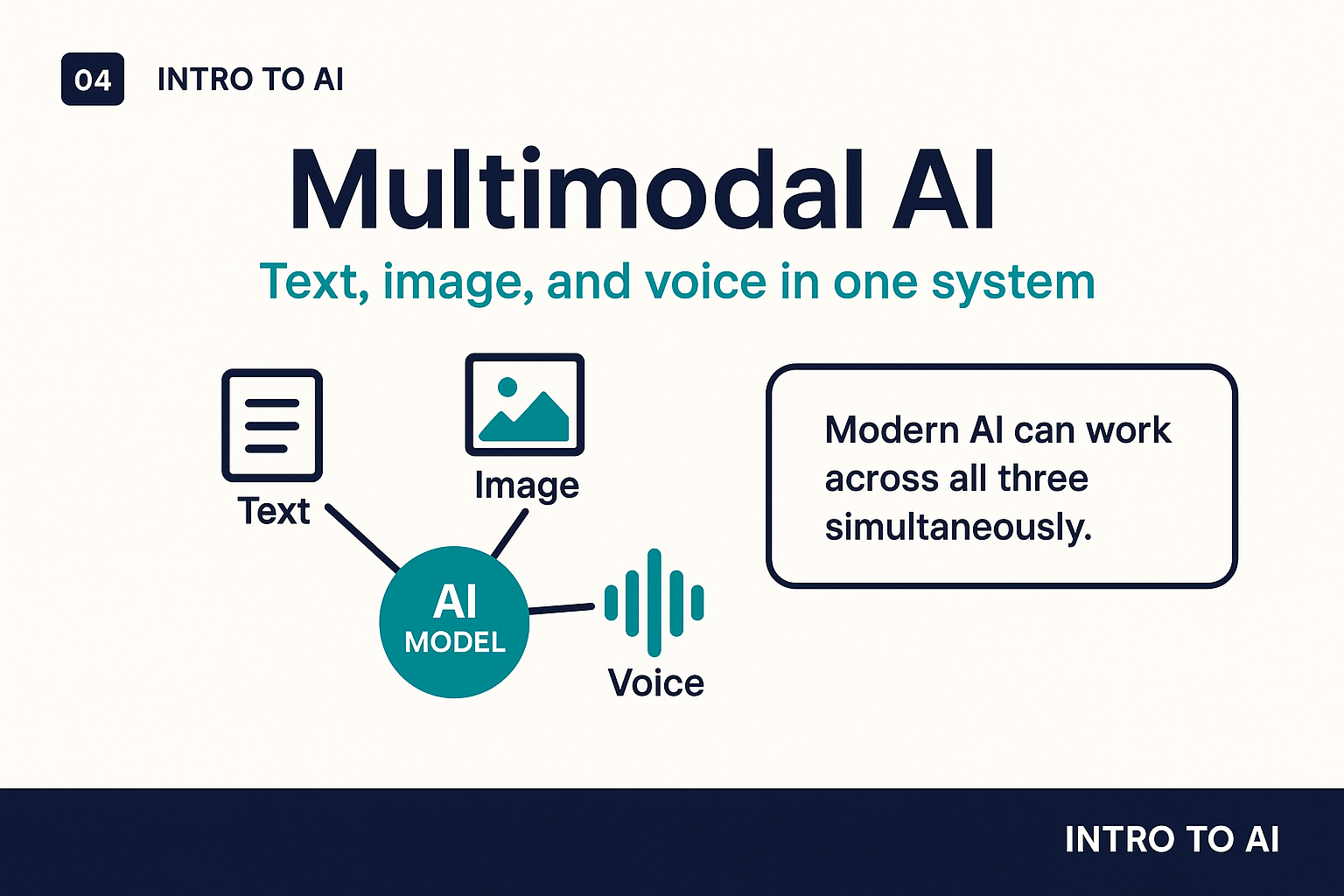
The same generative principles extend to audio. Voice synthesis models can now produce speech that is nearly indistinguishable from a real person's voice. Music generation models can compose in the style of any genre. And the boundaries between modalities are blurring: multimodal systems can take in text, images, and audio simultaneously, and produce output in any of those forms.
The practical implication is that the "AI" you interact with is increasingly not a single system but an ensemble. A modern AI assistant might use a language model to understand your request, an image model to produce a visual, a voice synthesis model to read the response aloud, and a retrieval system to look up current information. These components work together in ways that are invisible to the user.
What it cannot do
Generative AI is remarkable at producing plausible-sounding, visually coherent, stylistically appropriate output. It is not remarkable at knowing whether that output is true or accurate. A language model does not have a fact-checking mechanism. It produces the most probable continuation of your prompt, which is often right but can be confidently wrong. An image model does not know what a person actually looks like. It produces an image that fits the statistical patterns of similar images in its training data.
The fluency of generative AI can make errors harder to spot, not easier. A poorly written wrong answer is easy to distrust. A perfectly written wrong answer requires the same critical reading as a perfectly written right one.
The creative partnership
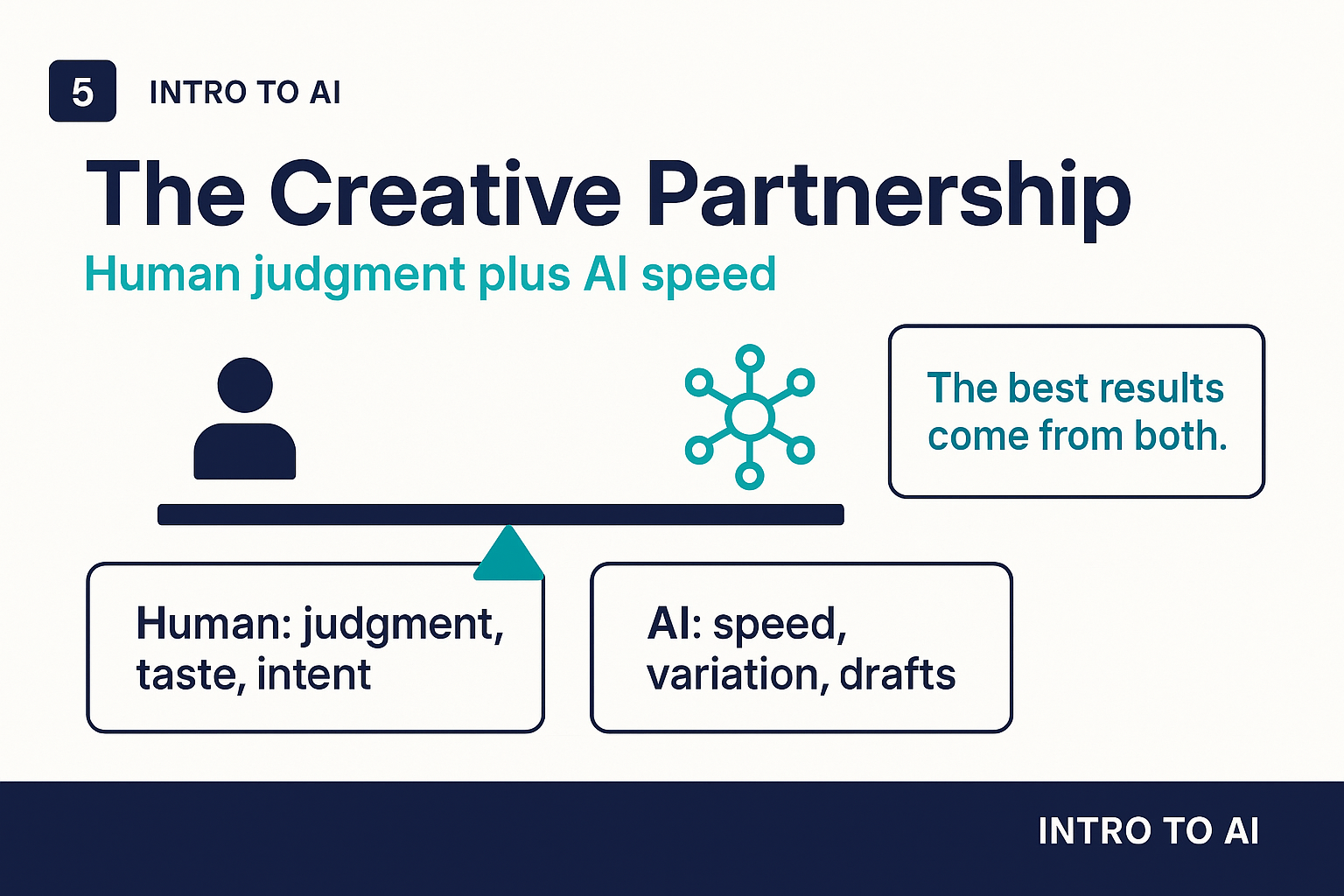
The most productive frame for generative AI is partnership rather than replacement. A skilled writer who uses AI to generate first drafts, explore variations, and get unstuck is not being replaced by the tool. They are offloading the parts of writing that are slow and mechanical so they can focus on the parts that require genuine judgment, taste, and intent.
The same logic applies to designers, analysts, developers, and almost anyone who produces knowledge work. The AI generates quickly and abundantly. The human selects, refines, and directs. The combination tends to be more productive than either alone, as long as the human stays in the loop where the loop matters.