A Short History of AI: How We Got Here
Part 2 of 12 — Intro to AI for non-technical backgrounds
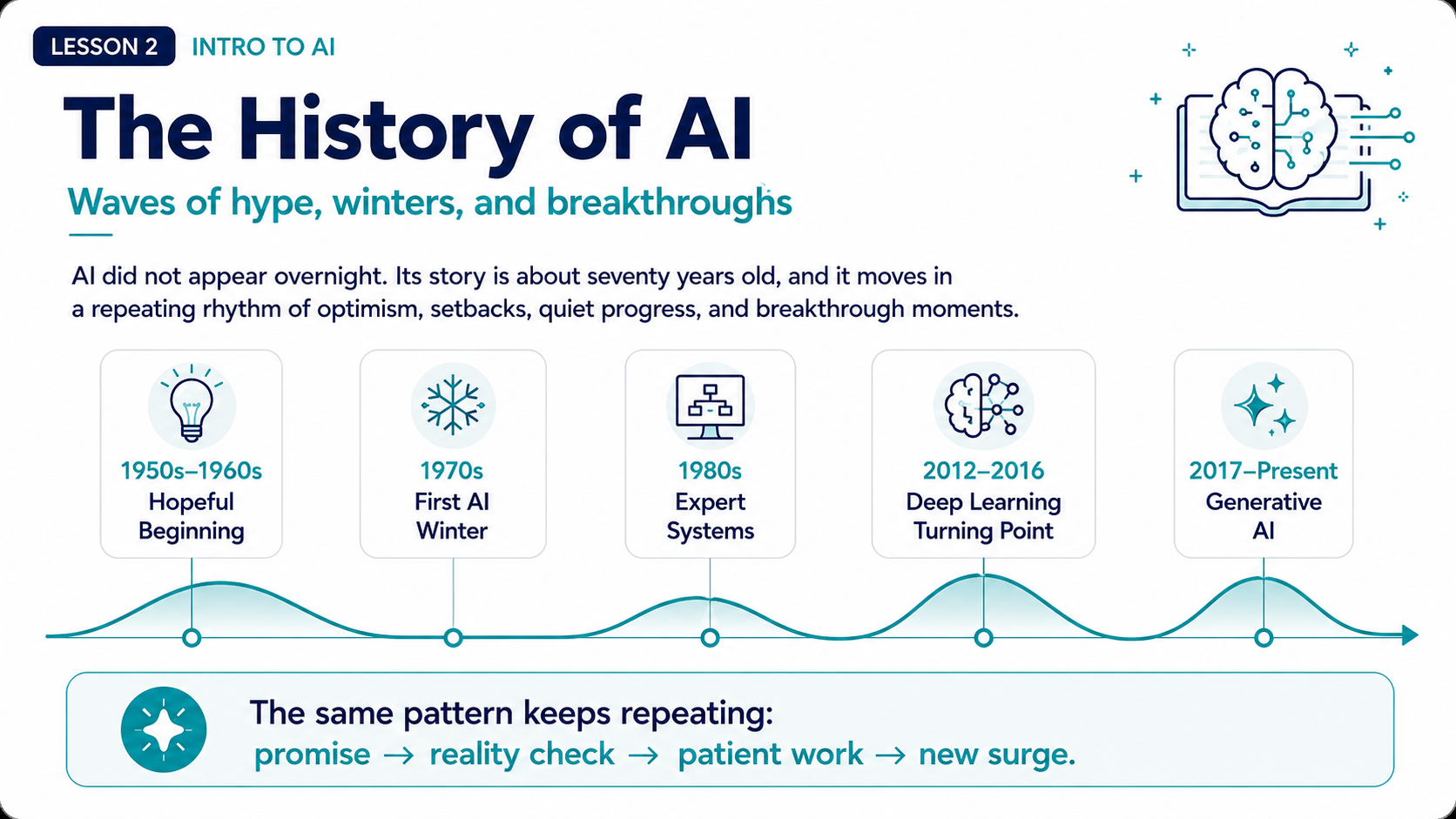
It is tempting to think AI burst onto the scene the day a chatbot first wrote a poem. In truth, the field is about seventy years old, and understanding its rhythm helps you read today's excitement with a steadier eye. The story is not one of steady progress. It is a story of waves: surges of optimism, painful collisions with reality, long periods of quiet work, and then sudden breakthroughs that surprised almost everyone.
The hopeful beginning: 1950s and 1960s
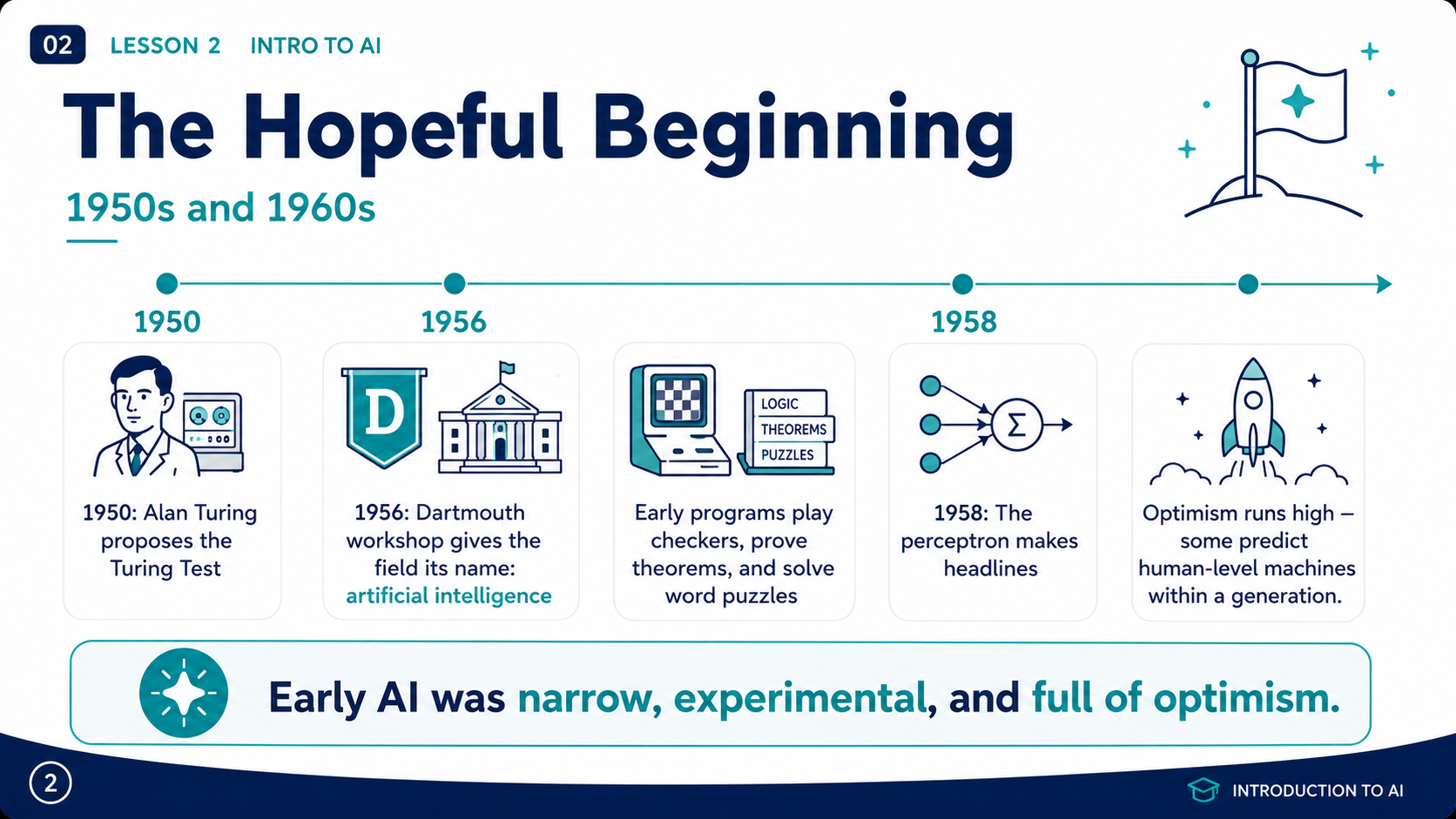
In 1950, the British mathematician Alan Turing published a paper asking a deceptively simple question: can machines think? He proposed a test, now called the Turing Test, where a machine would be judged intelligent if it could converse in a way indistinguishable from a human. That single question shaped the ambitions of a generation of researchers.
In 1956, a summer workshop at Dartmouth College gathered the small group of people who would found the field. They named it "artificial intelligence" and set out to build thinking machines. Within a few years, early programs could play checkers, prove geometric theorems, and solve word puzzles. The perceptron, an early model of a neuron, made headlines in 1958. Some researchers predicted human-level machines within a generation. Funding flowed freely. The optimism was genuine and, in hindsight, breathtaking in its confidence.
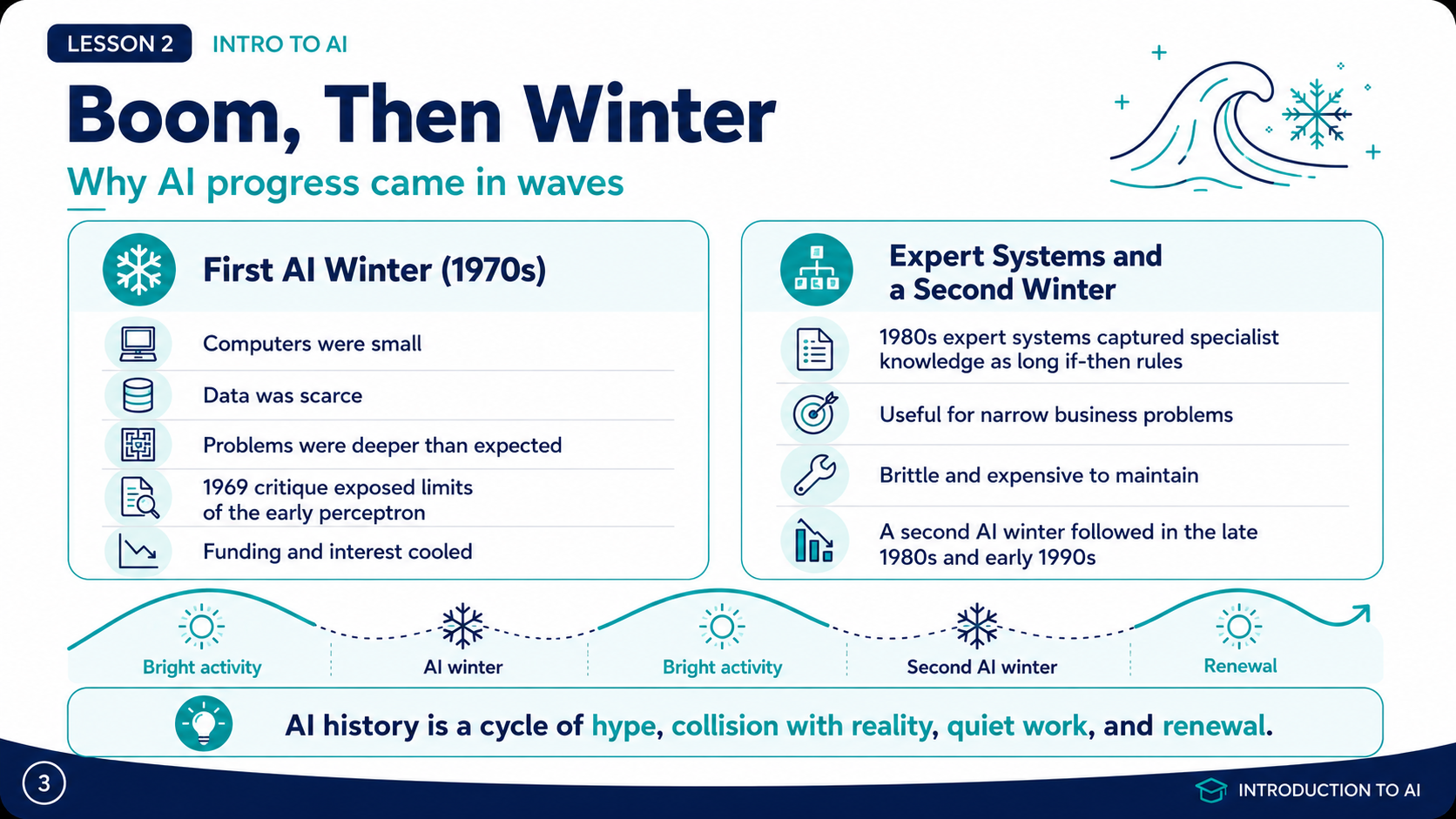
Boom, then winter
Reality proved far harder than expected. The computers of the 1960s and 1970s were tiny by today's standards, the data available was scarce, and the problems researchers had chosen turned out to be far deeper than anyone had imagined. A landmark 1969 critique exposed fundamental limits in the early perceptron. Funding dried up. Interest cooled. The field entered what historians now call the first AI winter: a stretch of years where progress stalled, promises went unfulfilled, and AI became almost a dirty word in funding circles.
The 1980s brought a partial recovery through expert systems: software that captured specialist human knowledge as long chains of if-then rules. A well-designed expert system could help doctors choose antibiotics, configure computer hardware, or diagnose certain equipment faults. They were genuinely useful for narrow, well-defined problems. But they were brittle, expensive to maintain, and unable to handle anything outside the rules they had been given. When the limitations became apparent, a second AI winter followed in the late 1980s and early 1990s.
The history of AI is a history of waves: a surge of optimism, a collision with reality, a quiet period of patient work, then a new surge built on better foundations.
The shift that changed everything
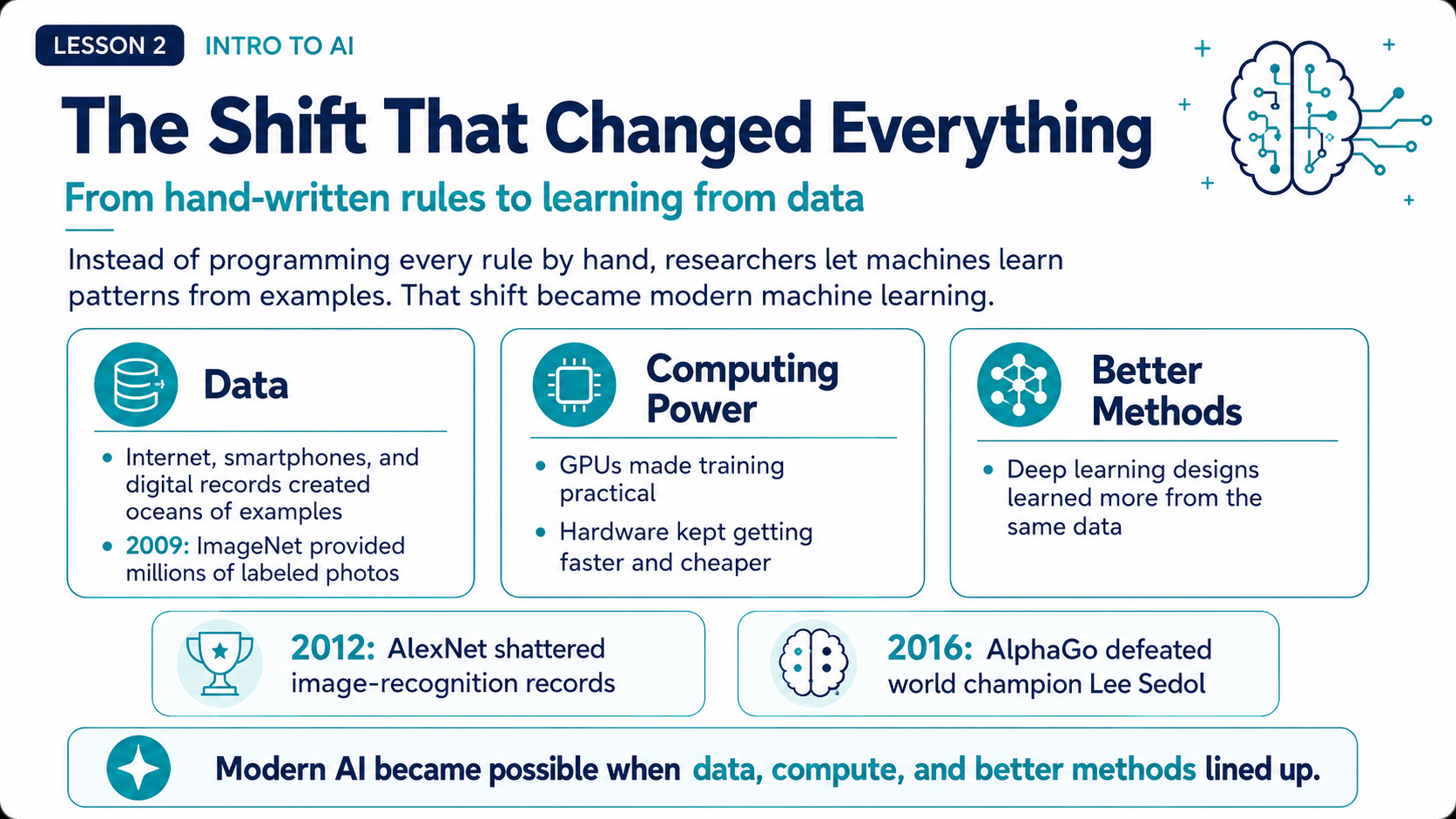
For decades, people tried to build intelligence by writing rules by hand: if this, then that. It worked for narrow, well-described problems but broke down in the messy, ambiguous real world. The breakthrough came from a change of strategy. Instead of programming the rules, researchers let machines learn the patterns from examples. This approach, machine learning, is the foundation of everything modern.
Three things had to come together before machine learning could work at the scale needed to produce impressive results, and they arrived in the 2000s and 2010s almost simultaneously:
- Data. The internet, smartphones, and the digitization of business records produced oceans of labeled examples. The ImageNet project alone collected and labeled 14 million photographs by 2009, giving researchers a benchmark for teaching machines to see.
- Computing power. Graphics processors originally designed for video games turned out to be extraordinarily well suited for the mathematics of neural network training. Hardware kept getting faster and cheaper. Training that would have taken years on 1990s hardware took days by 2012.
- Better methods. Researchers developed smarter architectures and training techniques that allowed systems to learn far more from the same data. Deep learning, which uses many layers of processing, proved dramatically more capable than shallower approaches.
In 2012, a deep learning system called AlexNet shattered the previous record on the ImageNet image recognition benchmark, cutting the error rate almost in half. It was a signal moment. The field suddenly knew that something qualitatively new had arrived.
The generative moment and the transformer era
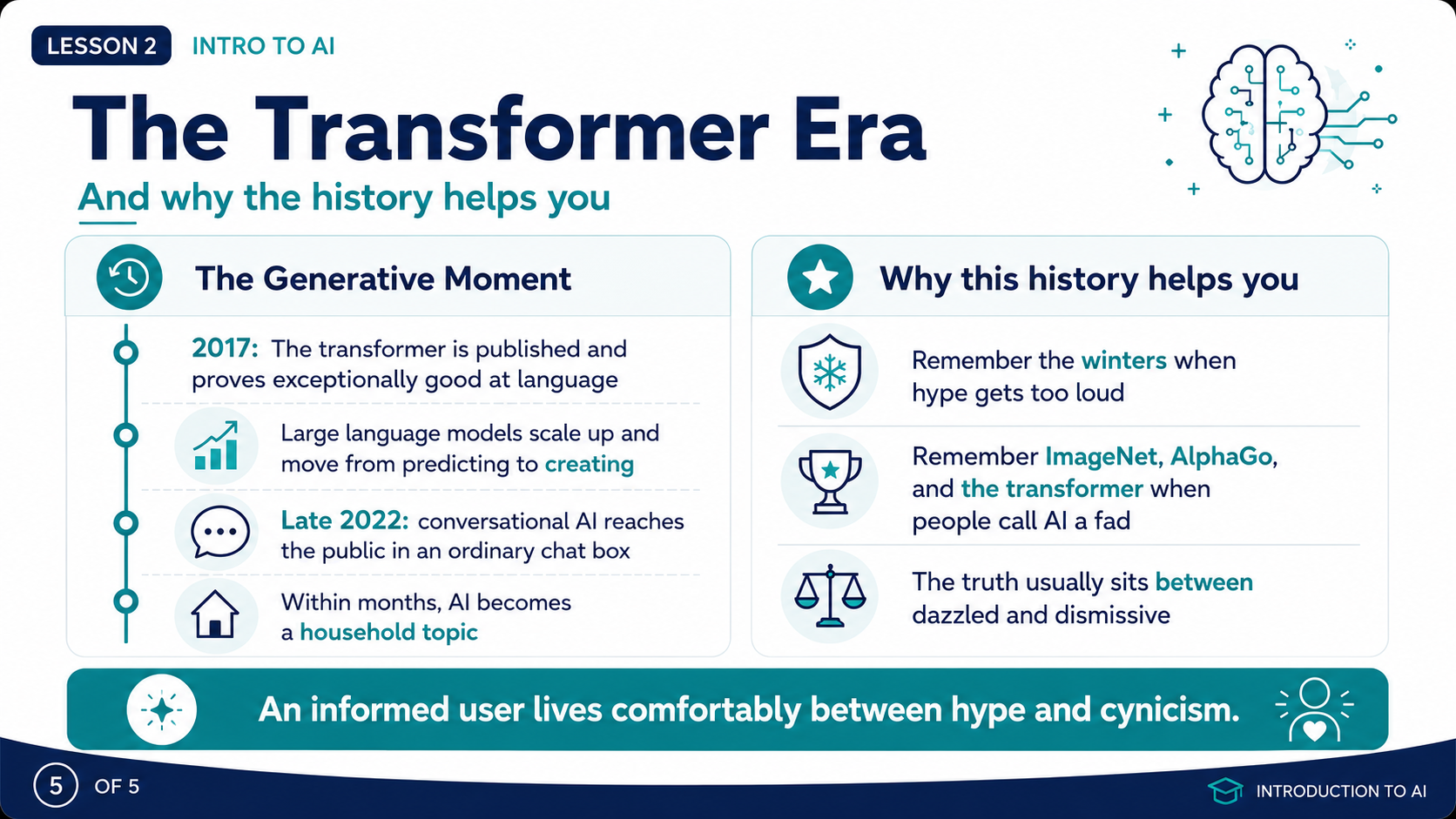
The most recent wave began with a 2017 paper titled "Attention Is All You Need," which introduced the transformer architecture. Transformers proved extraordinarily good at understanding and generating language by learning which parts of a sentence matter most to each other. Large language models built on this architecture scaled up rapidly, moving from predicting text to generating it in ways that felt genuinely creative.
In late 2022, conversational AI reached ordinary people through a simple chat interface, and within months it became a household topic. The pattern was the same as every previous wave: patient research, a convergence of enabling factors, and then a breakthrough that surprised even the people building it.
Why the history helps you
Knowing this arc gives you calibration that most people lack. When you hear that AI will transform everything within two years, you can remember the winters. When someone insists AI is just a passing fad, you can remember AlexNet, AlphaGo, and the transformer. The truth in every wave has sat somewhere between the most excited predictions and the most cynical dismissals.
An informed user lives comfortably in that middle space. The tools you have access to today are genuinely powerful, built on decades of hard-won insight. They also have real limits that we will spend the rest of this course understanding.