
The Difference Between Rules-Based Automation and AI
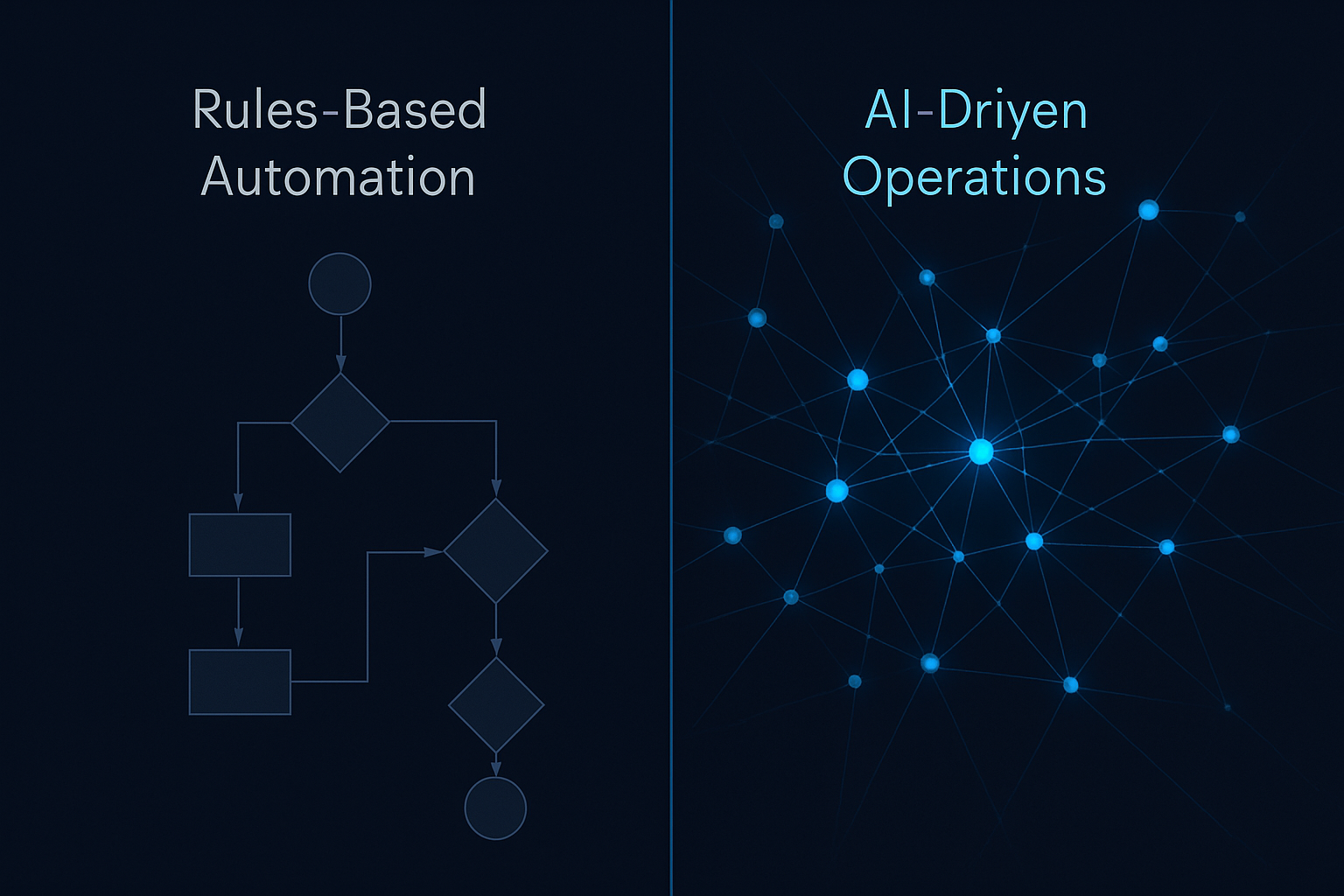
Part 1 of 5 — AI for Operations & Supply Chain
If you have worked in operations for any length of time, you have already used automation. Maybe it is a macro in Excel that reformats your weekly inventory report. Maybe it is an ERP workflow that kicks off a purchase order when stock hits a threshold. Maybe it is an email rule that routes supplier confirmations into a specific folder. Maybe it is a barcode scan that triggers a warehouse location update.
You might not call these things "automation." You might just call them "how we do things." But they are automation. And they all work the same way under the hood.
A human writes a rule. The system follows it. Every time, the same way, no variation.
That is rules-based automation. It is the backbone of modern operations. It is also the ceiling that AI is about to raise.
How rules-based automation actually works
Let us break this down plainly because the distinction matters for everything that follows in this course.
Rules-based automation operates on a simple formula: if this condition is true, then do this action. Sometimes the conditions are chained together. Sometimes there are branches. But the core logic is always the same. A human anticipated a situation, wrote instructions for handling it, and the software executes those instructions exactly as written.
Here are some examples you probably recognize.
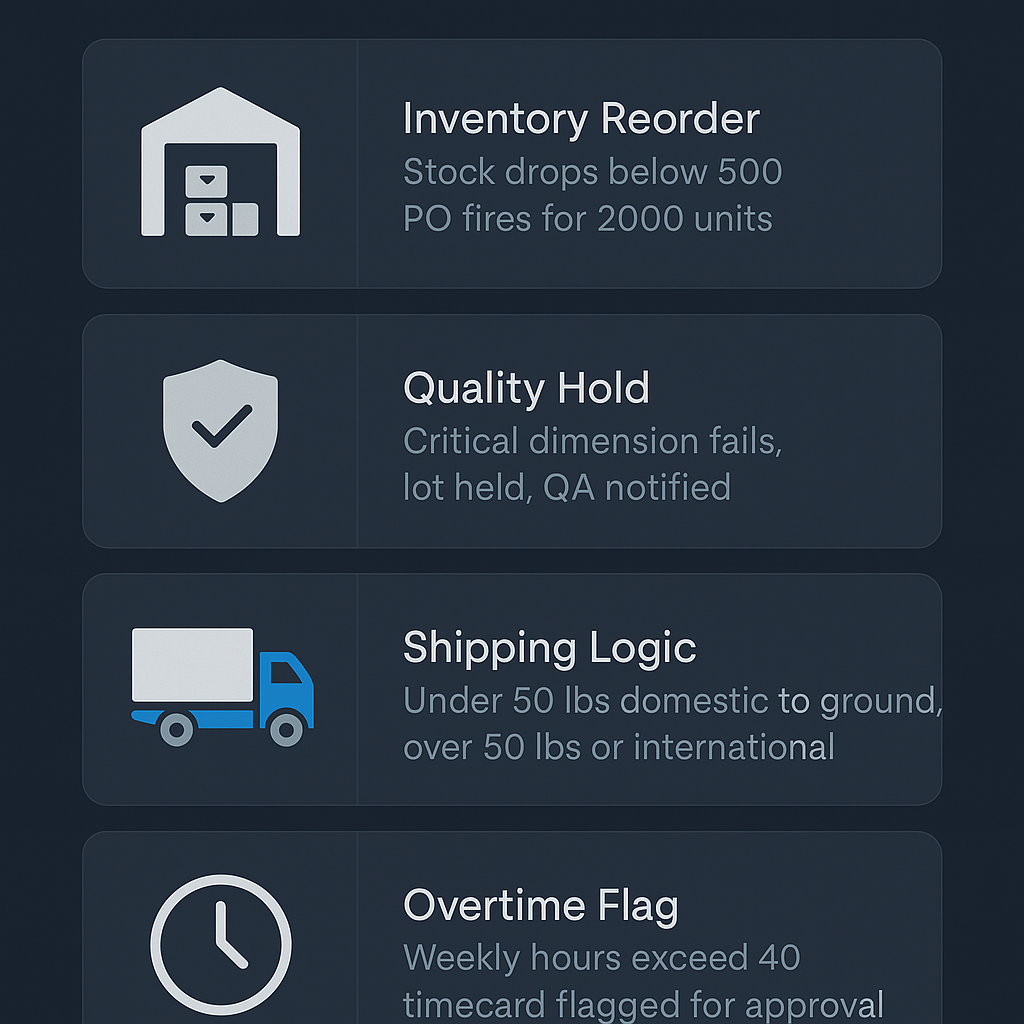
Inventory reorder point: If the stock level for SKU-4471 drops below 500 units, generate a purchase order for 2,000 units from Supplier A. Someone chose 500 as the threshold. Someone chose 2,000 as the order quantity. Someone chose Supplier A. The system just watches the number and fires when it hits the trigger.
Quality hold: If an incoming inspection fails on any critical dimension, place the lot on hold and send a notification to the quality manager. Someone defined which dimensions are critical. Someone defined what "fail" means for each one. The system checks the boxes.
Shipping logic: If the order weighs under 50 lbs and the destination is domestic, use ground shipping. If it weighs over 50 lbs or the destination is international, route to the freight desk for manual quoting. Someone drew the line at 50 lbs. Someone decided domestic versus international was the right split. The system sorts accordingly.
Overtime approval: If an employee's weekly hours exceed 40, flag the timecard for supervisor approval before payroll processing. The rule is the rule. It does not care whether the overtime was planned or unplanned, whether the department is understaffed, or whether the project deadline justifies the extra hours. It sees 40+ and it flags.
Every one of these works. They are reliable. They are fast. They run 24/7 without complaining. And they have a fundamental limitation that most ops teams have learned to live with: they can only handle what someone thought of in advance.
If the world changes and nobody updates the rule, the system keeps doing the old thing. If a situation falls between the rules, the system does nothing. If the optimal answer depends on a dozen factors that interact in unpredictable ways, the rules either become impossibly complex or they settle for "good enough."
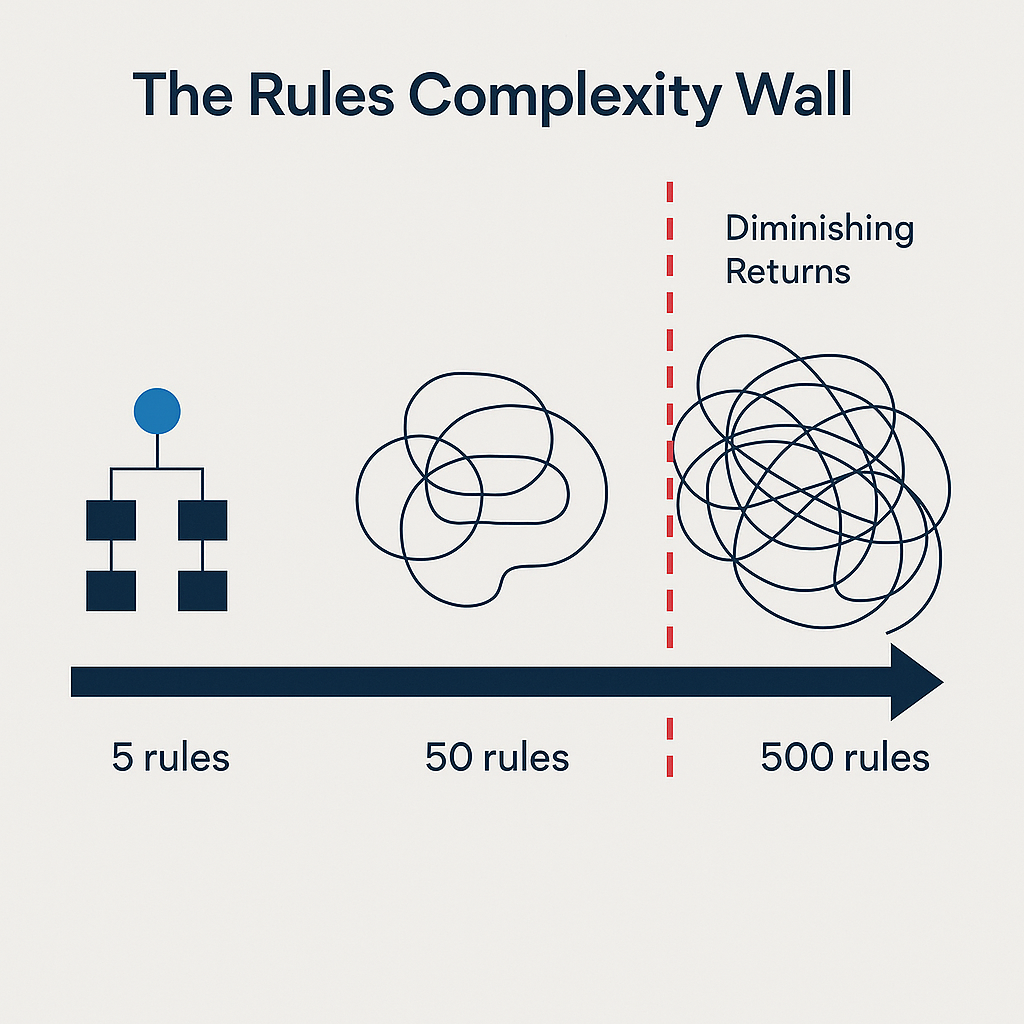
Operations teams have been building increasingly elaborate rule systems for decades. More conditions. More branches. More exception handling. More edge case logic. At some point the rule tree gets so complicated that nobody fully understands it anymore, and maintaining it becomes a job in itself.
This is the wall that rules-based automation hits. Not a failure of technology. A failure of the approach. Some problems have too many variables, too much variability, and too much change for any human to write rules fast enough to keep up.
That is where AI enters the picture.
So what is AI doing differently?
AI flips the model. Instead of a human writing the rule, the system looks at data and figures out the pattern on its own.
This is not a small difference. It is a fundamentally different way of solving problems.
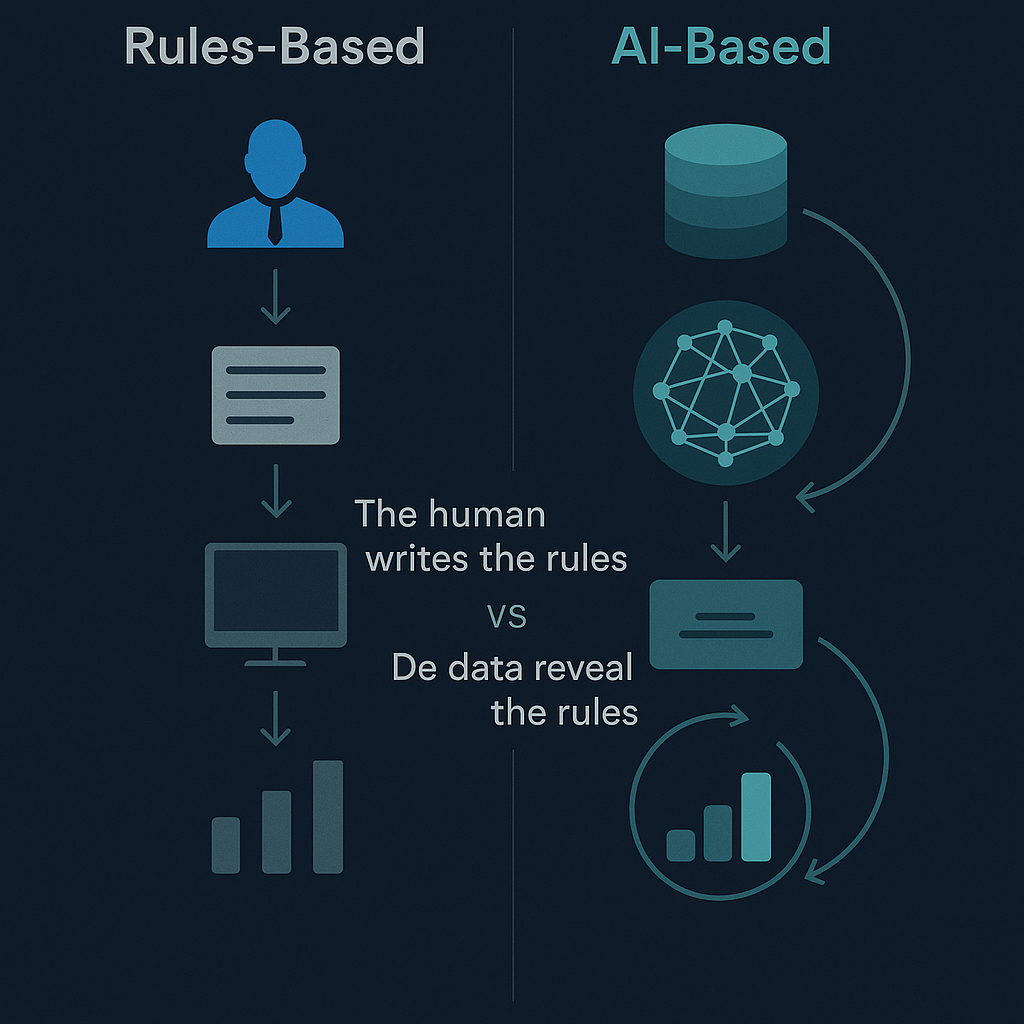
With rules-based automation, the human is the expert. The human observes the process, identifies the patterns, translates those patterns into logic, and codes that logic into the system. The software is just an executor. It does not "understand" anything. It is a very fast, very obedient clerk.
With AI, the system itself becomes a kind of pattern-finder. You give it data (lots of data) and it identifies relationships, correlations, and structures that produce useful predictions or decisions. The human's role shifts from writing the rules to defining the goal, supplying the data, and evaluating whether the results are good enough.
Here is a concrete example to make this tangible.
Rules-based approach to demand forecasting:
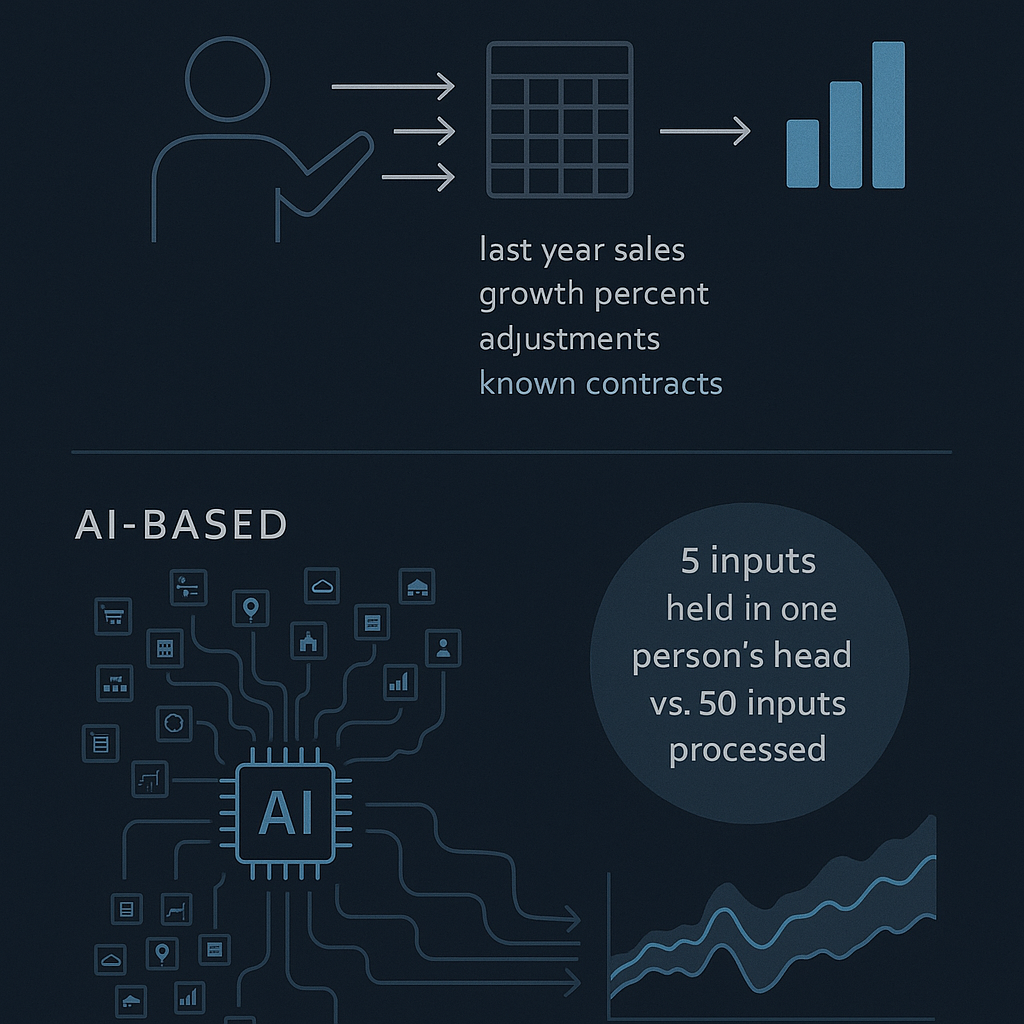
You sit down in September to build next year's Q1 forecast. You pull last year's Q1 actuals. You look at the overall growth trend and decide to apply an 8% increase. You know January is always slow because of holiday hangover, so you reduce January by 12% and redistribute to February and March. You know one major customer committed to a larger contract starting in March, so you add 15% to March for that product line. You build the spreadsheet, adjust the numbers until they feel right, and send it to finance.
You wrote every rule. You chose every number. You made every judgment call. The spreadsheet just did arithmetic.
This approach works. It has worked for decades. But notice what it depends on: your memory, your experience, your judgment, and your ability to hold maybe five or six factors in your head at once while making tradeoffs between them. Most experienced ops managers can do this well. Some can do it very well.
But nobody can do it across 5,000 SKUs, 30 customers, 8 warehouses, and 12 months simultaneously while also accounting for commodity price trends, weather patterns, competitor behavior, and macroeconomic shifts. The human brain was not built for that kind of multivariable optimization. And that is not a criticism. It is just a fact about how human cognition works.
AI-based approach to demand forecasting:
You feed the system three years of order history broken down by SKU, customer, region, and channel. You add external data: weather history, commodity price indices, promotional calendars, economic indicators, maybe even shipping carrier delay data. You tell the system the goal: predict demand at the SKU-location level for the next 90 days, updated weekly.
The AI processes all of it. It finds correlations you never would have tested. Maybe it discovers that a specific combination of humidity levels in the southeast and a competitor's pricing move on a substitute product predicts a demand spike for your product two weeks before it shows up in actual orders. No human wrote that rule. No human even hypothesized that relationship. The AI found it in the data because it tested thousands of possible combinations and kept the ones that improved prediction accuracy.
And here is the part that matters most for operations: as new data comes in, the model updates. If the pattern shifts (if that humidity-pricing correlation stops being predictive because the competitor changed strategy), the AI adapts. A rules-based system would keep applying the old rule until someone manually noticed it was wrong and rewrote it.
Three more examples across operations
Demand forecasting is the most common example, but AI versus rules plays out across every function in operations. Here are three more to build your intuition.
Supplier risk monitoring
Rules-based: You review each supplier quarterly using a scorecard. On-time delivery above 95% is green. Between 90-95% is yellow. Below 90% is red. You pull the numbers, fill in the scorecard, and have a conversation with procurement about the reds.
AI-based: The system continuously monitors each supplier's delivery performance, financial filings, news mentions, geographic risk factors, raw material price exposure, and their own suppliers' performance. It detects that a tier-2 supplier in Southeast Asia is showing early signs of financial distress based on a pattern that historically precedes delivery failures by 60-90 days. Your tier-1 supplier sources a critical component from them. The AI flags the risk before anything has actually gone wrong yet. Your quarterly scorecard would not have caught this because by the rules, everything still looks green.
Production scheduling
Rules-based: You run the MRP. It explodes the BOM, checks inventory and lead times, and generates a production schedule based on due dates and standard run times. If two jobs compete for the same machine, the one with the earlier due date goes first. If a machine goes down, you manually reschedule.
AI-based: The system considers due dates, machine efficiency curves by operator and shift, historical setup times by job sequence (not just standard times), quality yield rates that vary by machine-product combination, energy costs by time of day, and current order priorities weighted by customer margin. It generates a schedule that balances on-time delivery, cost, and quality simultaneously. When a machine goes down, it reschedules in seconds, not hours, and it factors in which rescheduling option has the lowest downstream impact on other orders.
Warehouse slotting
Rules-based: Fast-moving items go in the prime pick locations closest to the shipping dock. Slow movers go to the back. You review the slotting annually, maybe quarterly, based on velocity data.
AI-based: The system analyzes order patterns (not just individual item velocity, but which items are frequently ordered together, seasonal shifts in demand by SKU, incoming replenishment schedules, and picker path efficiency). It recommends dynamic slotting that changes weekly based on anticipated order profiles. During the holiday rush, it pre-positions seasonal kits near the pack stations before the volume spike actually arrives, because it learned from last year's data that those orders cluster in a specific five-day window.
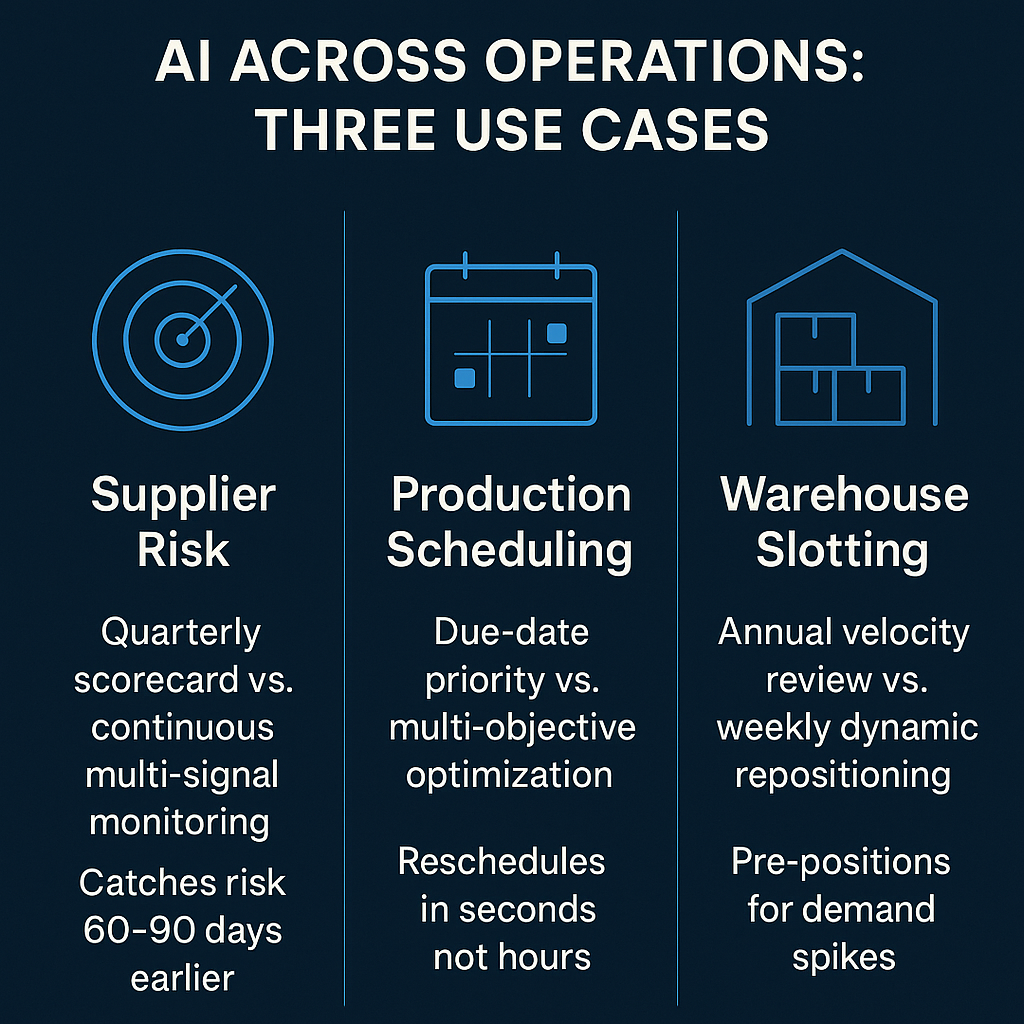
In every one of these examples, the rules-based approach works. It is not broken. But it leaves value on the table because it cannot adapt to complexity the way a data-driven model can.
Where this matters for ops managers
This distinction is not academic. It changes what you can automate, what you should expect from the tools you buy, and how you allocate your team's time and attention.
Rules-based automation is the right choice when the process is stable, well-understood, and rarely changes. Routing a purchase order for approval. Calculating overtime pay. Generating a standard report every Monday morning. Sending an alert when a temperature sensor in cold storage exceeds a threshold. These are solved problems. You do not need AI for them. Adding AI would be overengineering, and overengineered systems are harder to maintain, harder to troubleshoot, and more expensive to run.
AI is the right choice when the process involves variability, uncertainty, or too many factors for a human to track simultaneously. Predicting which supplier is likely to miss a delivery window. Deciding how much safety stock to hold across 200 SKUs in 12 warehouses. Detecting a quality anomaly in production data before it becomes a line shutdown. Optimizing a delivery route across 80 stops with time windows, vehicle capacity constraints, and live traffic data.
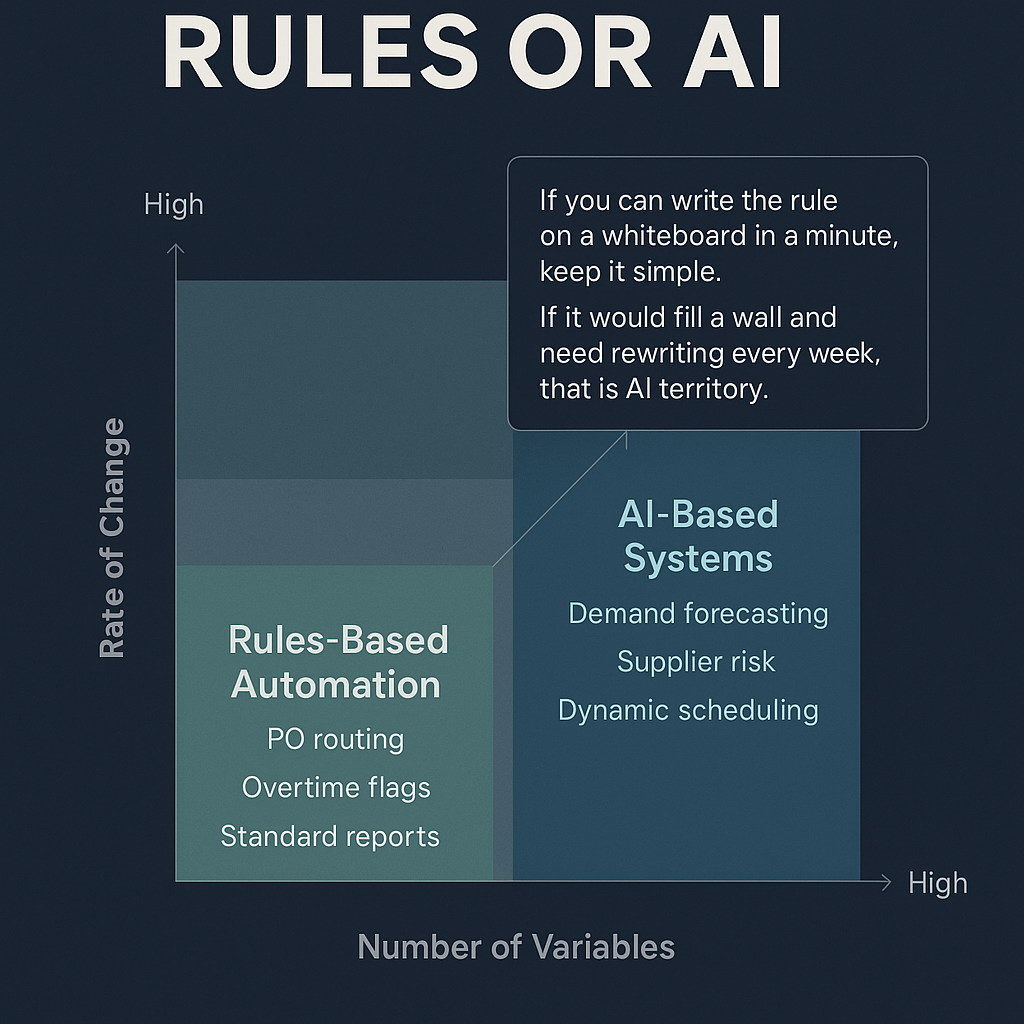
The practical test is straightforward. If you can write the rule on a whiteboard in under a minute and it will still be correct six months from now, you probably do not need AI. Use a simple automation and move on.
If the "rule" would require a whiteboard the size of a wall, would need to be rewritten every few weeks as conditions change, and would still miss edge cases because there are too many interacting variables, that is where AI earns its keep.
What AI is NOT doing
This is worth stating clearly because the vendor marketing will try to blur these lines.
AI is not thinking. It is not reasoning the way you reason when you walk the production floor and notice something feels off. It does not understand your business. It does not have judgment. It does not have common sense.
What it does is find patterns in data. Very complex patterns, across very large datasets, very quickly. That is genuinely powerful. It is also genuinely limited.
An AI demand forecasting model might produce a prediction that looks absurd (a 400% spike in demand for a product you know is being discontinued). That does not mean the AI is "wrong" in a way that discredits it. It means the AI is working from the data it has, and the discontinuation decision is not in that data. The model did its math correctly. It just did not know something important.
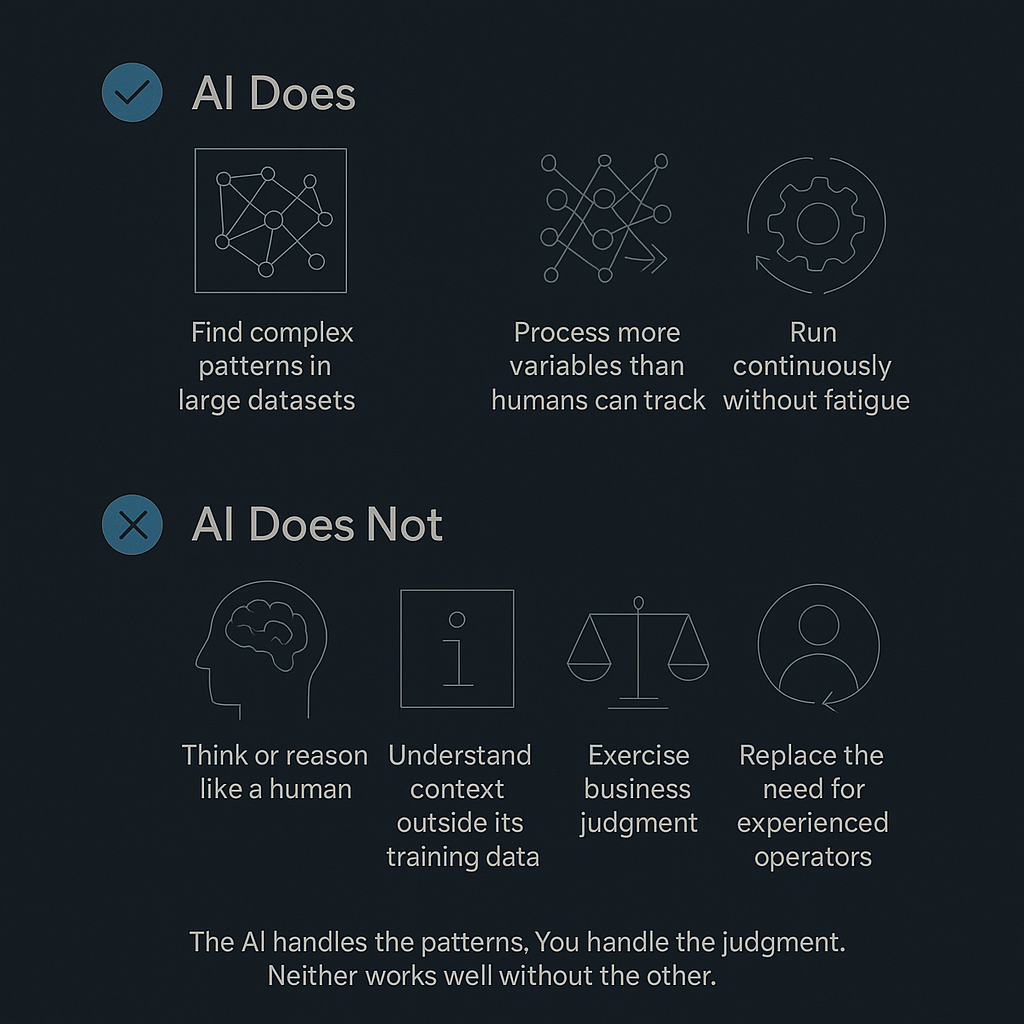
This is why AI does not replace ops managers. It replaces the tedious parts of what ops managers do (the data crunching, the pattern searching, the monitoring of dozens of variables across hundreds of items). It frees you up to do the parts that require actual judgment: deciding whether the AI's recommendation makes sense, handling the exceptions, managing the relationships, and making the calls that depend on context no dataset can capture.
Throughout this course, we will keep coming back to this division of labor. The AI handles the patterns. You handle the judgment. Neither one works well without the other.
The key mental shift
Most ops professionals have spent their careers building better rules. Better SOPs. Better checklists. Better escalation procedures. Better KPI dashboards with conditional formatting. That instinct is correct. It is valuable. It is the foundation of operational excellence. AI does not replace it.
What AI adds is the ability to handle the gray areas between your rules. The situations where the answer is "it depends" and the number of things it depends on is too large for a human to hold in their head at once. The situations where the right answer today is different from the right answer last Tuesday, and different again from the right answer next Thursday, and figuring out why requires comparing 40 variables across 18 months of history.
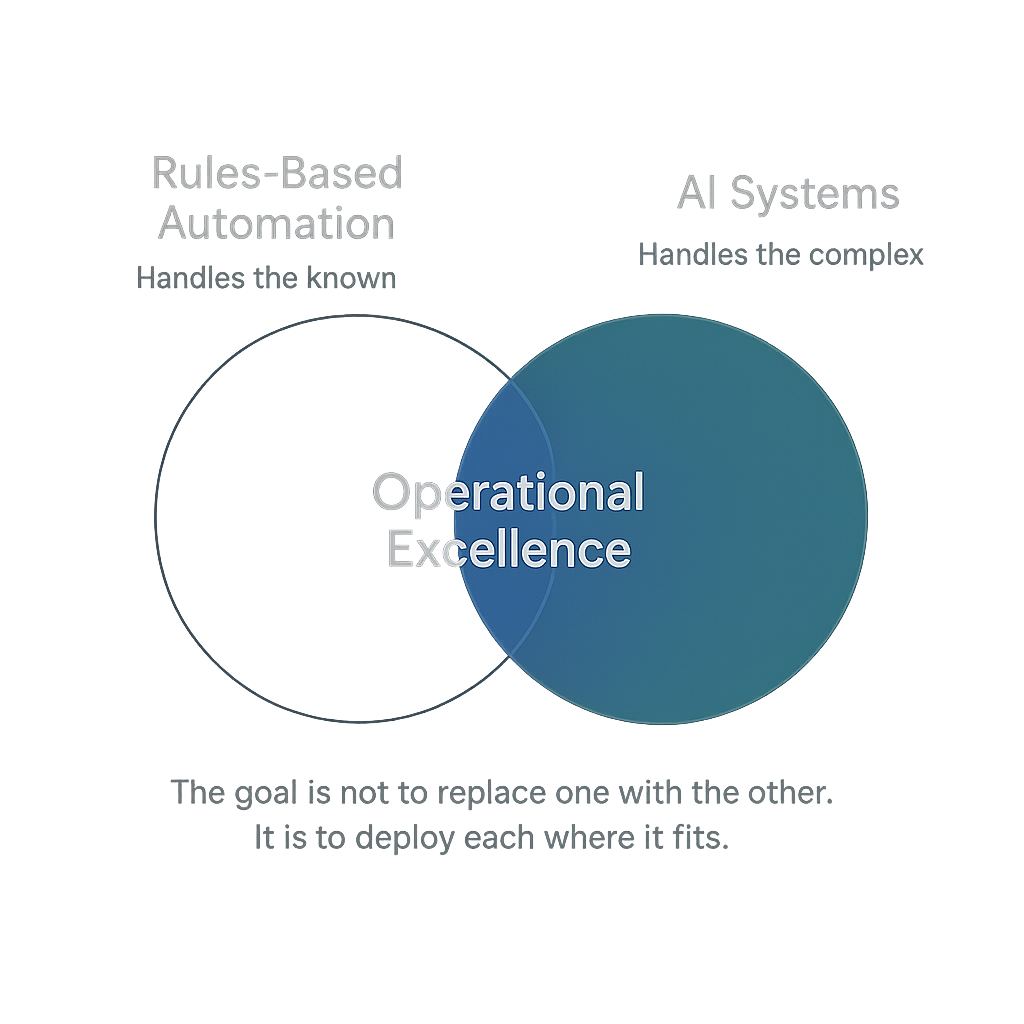
Your rules handle the known. AI handles the complex. The combination is where operations teams gain a real edge.
Key takeaways
- Rules-based automation executes logic that a human defined. It is reliable, predictable, and limited to what someone anticipated in advance.
- AI-based systems learn patterns from data. They handle more variables, adapt over time, and surface insights no one thought to look for.
- AI does not replace rules-based automation. It extends it into territory where static rules break down due to complexity, variability, or scale.
- AI is not thinking or reasoning. It is finding patterns in data. That is powerful but limited. Human judgment is still essential.
- The practical test for any process: is this a rules problem or a patterns problem? If you can write the rule on a whiteboard in a minute, keep it simple. If the rule would fill a wall and need constant rewriting, that is AI territory.
Next lesson: What "Learning from Data" Actually Means.