
What "Learning from Data" Actually Means
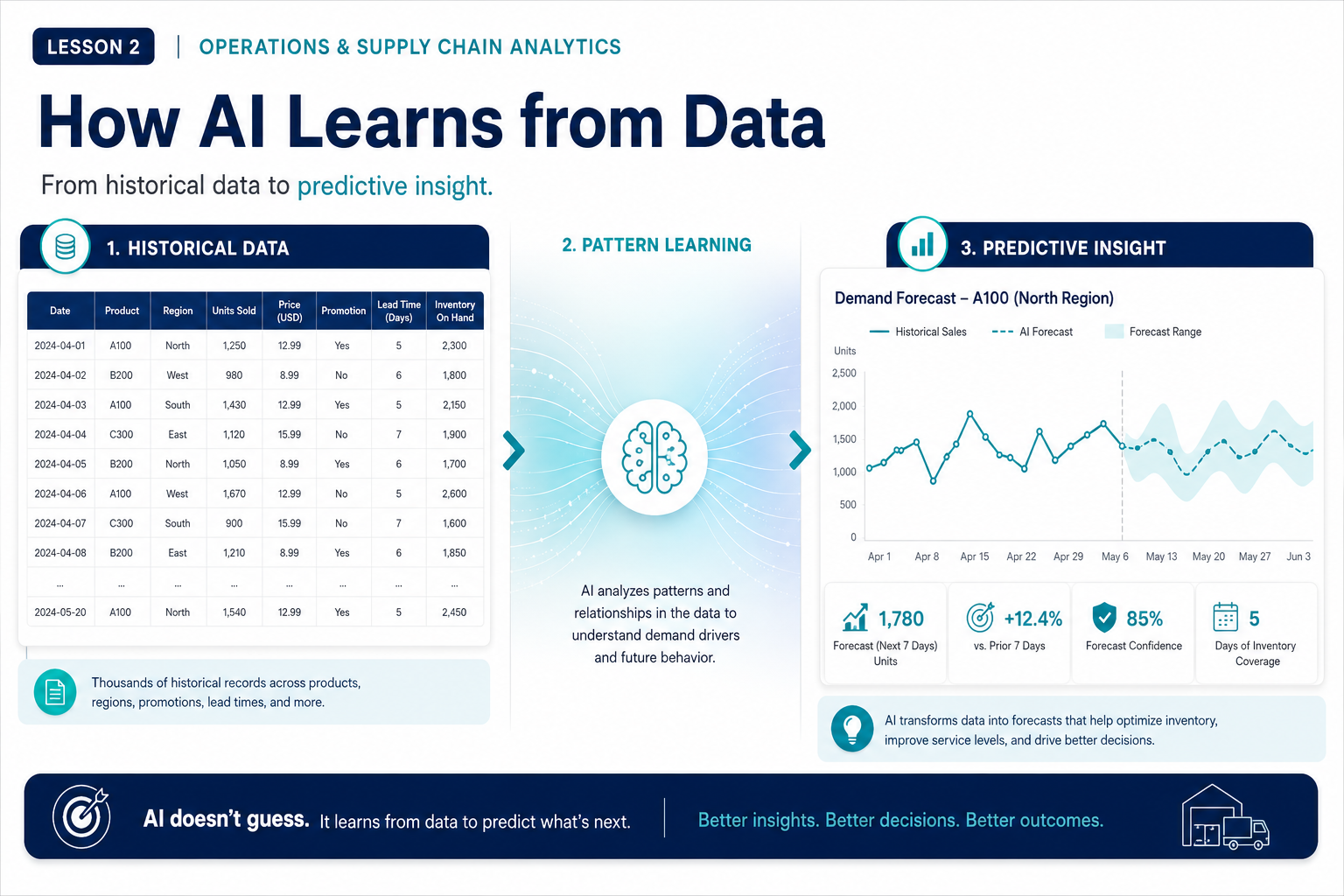
Part 2 of 5 — AI for Operations & Supply Chain
Lesson 1 ended with a claim: AI finds patterns in data that rules-based systems cannot handle. That is a dense sentence. And the phrase "learning from data" gets thrown around so much that it has lost most of its meaning.
Let us unpack it carefully because understanding this process is the difference between treating AI like magic and treating it like a tool you can actually work with.
The human analogy
Think about how an experienced operations manager learns a new process. When you first took the role, you did not know what to watch for. You handled a few situations. Things went wrong in ways you did not expect. You learned from those mistakes. A few months in, you started recognizing patterns: this supplier tends to slip when the order is large and the timing hits quarter end. That machine runs better with a specific operator during the night shift. The January forecast is always too optimistic because it does not account for the holiday hangover.
You built that knowledge from experience. Each real-world example refined your mental model. Over time your intuition became genuinely reliable for that domain. You just cannot articulate exactly how you know what you know, and you cannot transfer that knowledge to someone else by writing it down.
That is essentially what AI does. It is the experience accumulation part, just automated, quantitative, and operating on a scale that far exceeds human capacity.
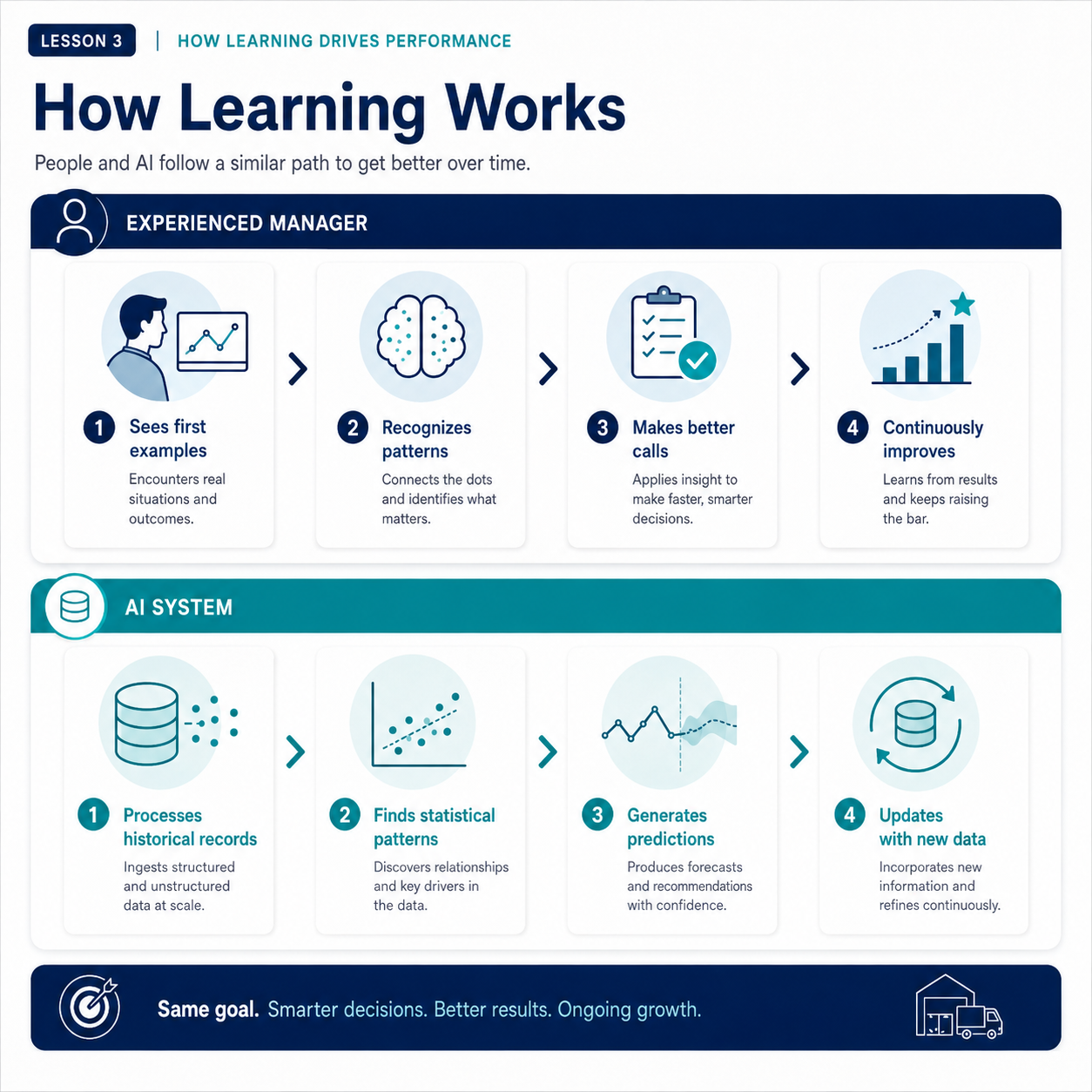
The analogy is not perfect. The system does not "understand" the way you do. It does not have intuition or common sense. But the core mechanism is structurally similar: see enough examples, recognize the patterns, make better calls over time. The system just processes thousands or millions of examples instead of dozens, and it tracks relationships across dozens of variables instead of the five or six that fit in your working memory.
A concrete example: predicting supplier delivery delays
Let us walk through how a learning system would actually work using data you probably already have.
Start with your purchase order history. Every PO has a promised delivery date and an actual delivery date. Some arrive on time. Some arrive early. Some arrive late by a day or two. A few arrive weeks late and cause production line stoppages.
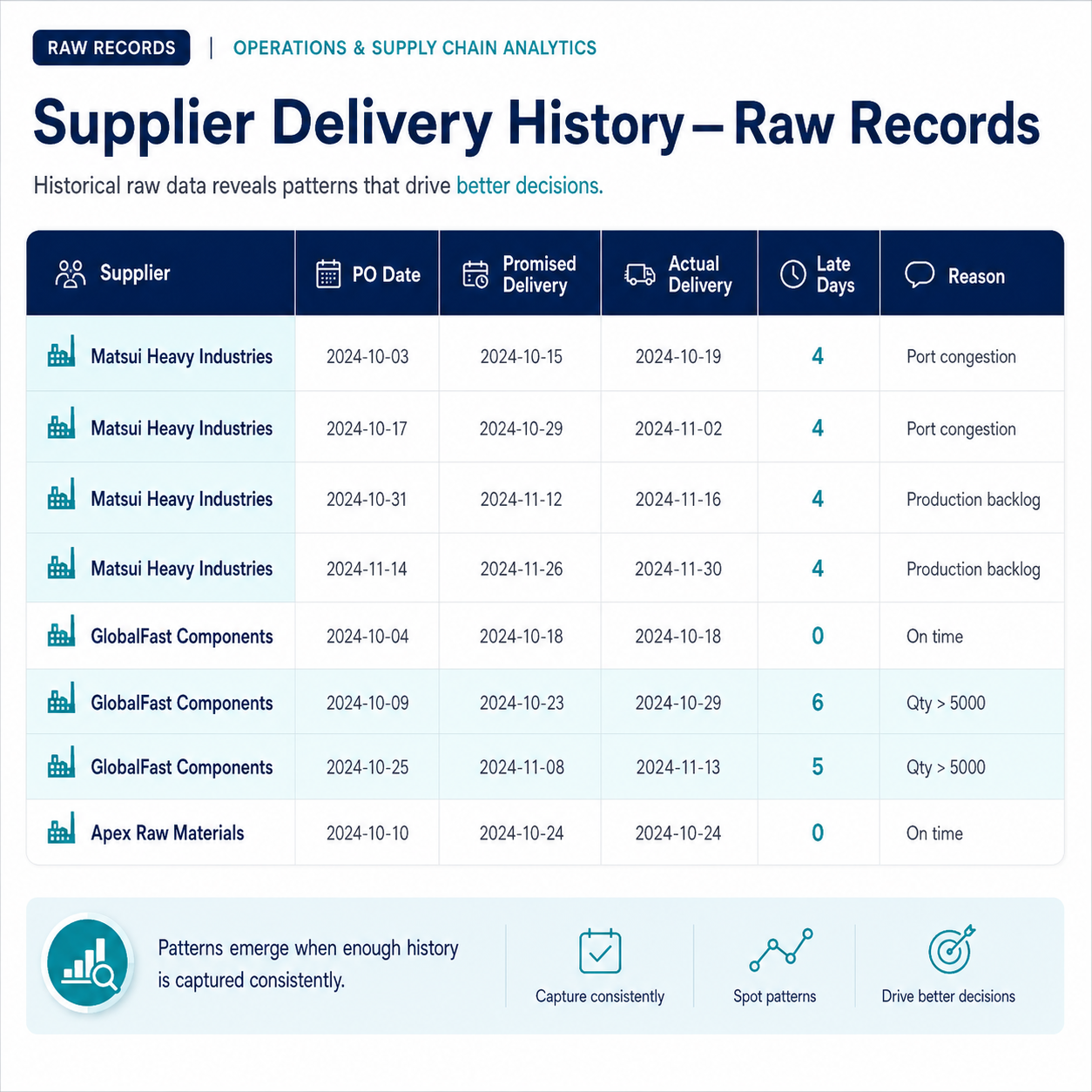
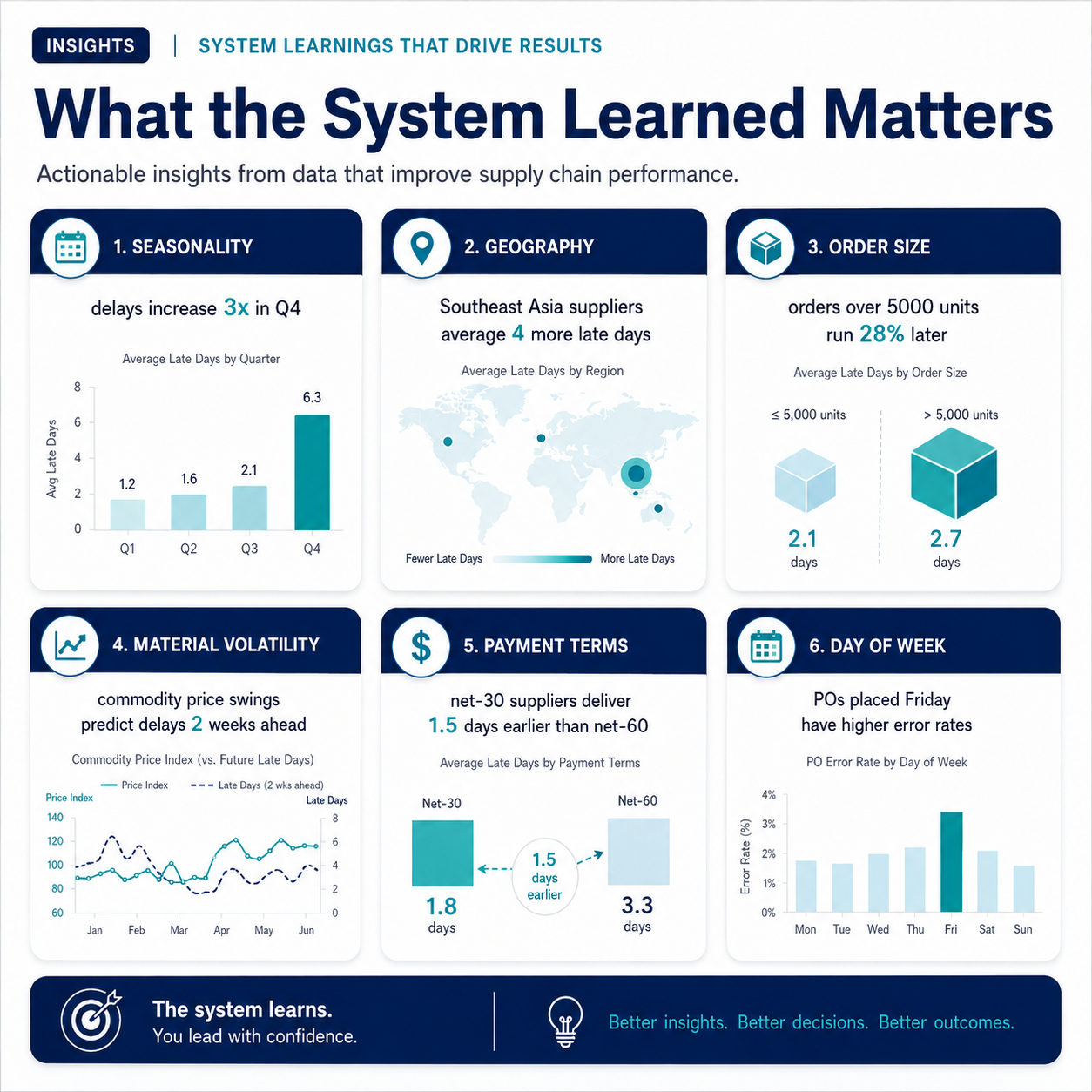
If you look at this data manually, you might notice a few obvious things. Supplier X is consistently late in the fourth quarter. Orders placed on Friday tend to have more errors. The largest orders always take longer than the standard lead time.
Those are the patterns that sit on the surface. The ones you can see by scanning the spreadsheet. A learning system goes deeper because it can test thousands of hypotheses simultaneously.
It might discover that delivery delays for a specific supplier cluster around three conditions combined: order quantities above 5,000 units placed within 14 days of a Chinese holiday when commodity prices have dropped more than 5% in the prior month. Any single condition is not a strong signal. The combination is highly predictive.
No human wrote that rule. No human even tested that specific combination. The system explored thousands of variable combinations and kept the ones that consistently improved prediction accuracy. That is learning from data.
Training versus prediction
There is one distinction that matters enormously if you want to understand how AI systems work. The learning process has two phases, and they are fundamentally different.
Training phase: The system studies historical data where the answer is already known. It looks at past purchase orders and their actual delivery dates. It tries to find patterns that connect order characteristics to outcomes. During training, the system has an answer key. It can check every prediction against reality and adjust its internal model accordingly.
This is equivalent to a student studying with the textbook open. They can see the question and the answer, and they internalize the patterns.
Prediction phase: The system faces new situations it has never seen before. New purchase orders with unknown outcomes. It applies everything it learned during training to make its best guess. There is no answer key during prediction. The system is operating on what it learned, not what it memorized.
This is the exam. Textbook closed. Can the system apply what it learned to situations it has never encountered?
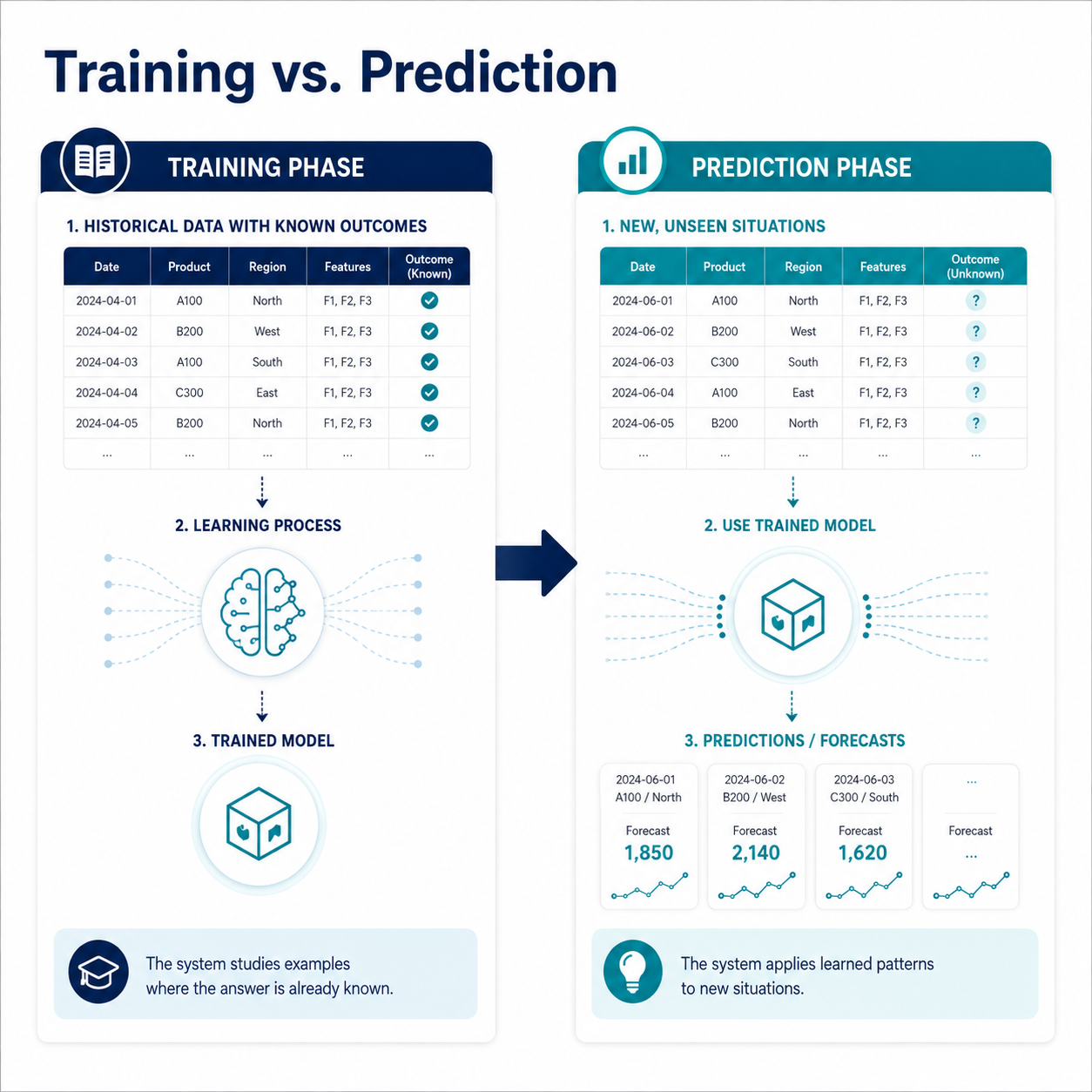
This distinction matters because it reveals how AI systems are evaluated. You test them the way you would evaluate any forecasting process: compare their predictions against actual outcomes over time. If the system predicts that PO-88921 will arrive 3 days late, and it arrives on time, that is a miss. You track the miss rate, the accuracy distribution, and the direction of errors. Over time you build confidence in the system the same way you build confidence in a team member's judgment: consistent performance across diverse situations.
The forms data takes in operations
Here is the part that surprises most ops professionals. You probably already have enough data to train useful models. The data just does not look like what people picture when they talk about AI.
It is not a pristine dataset in a analytics warehouse. It is scattered across systems, formats, and processes that were designed for operations, not machine learning.
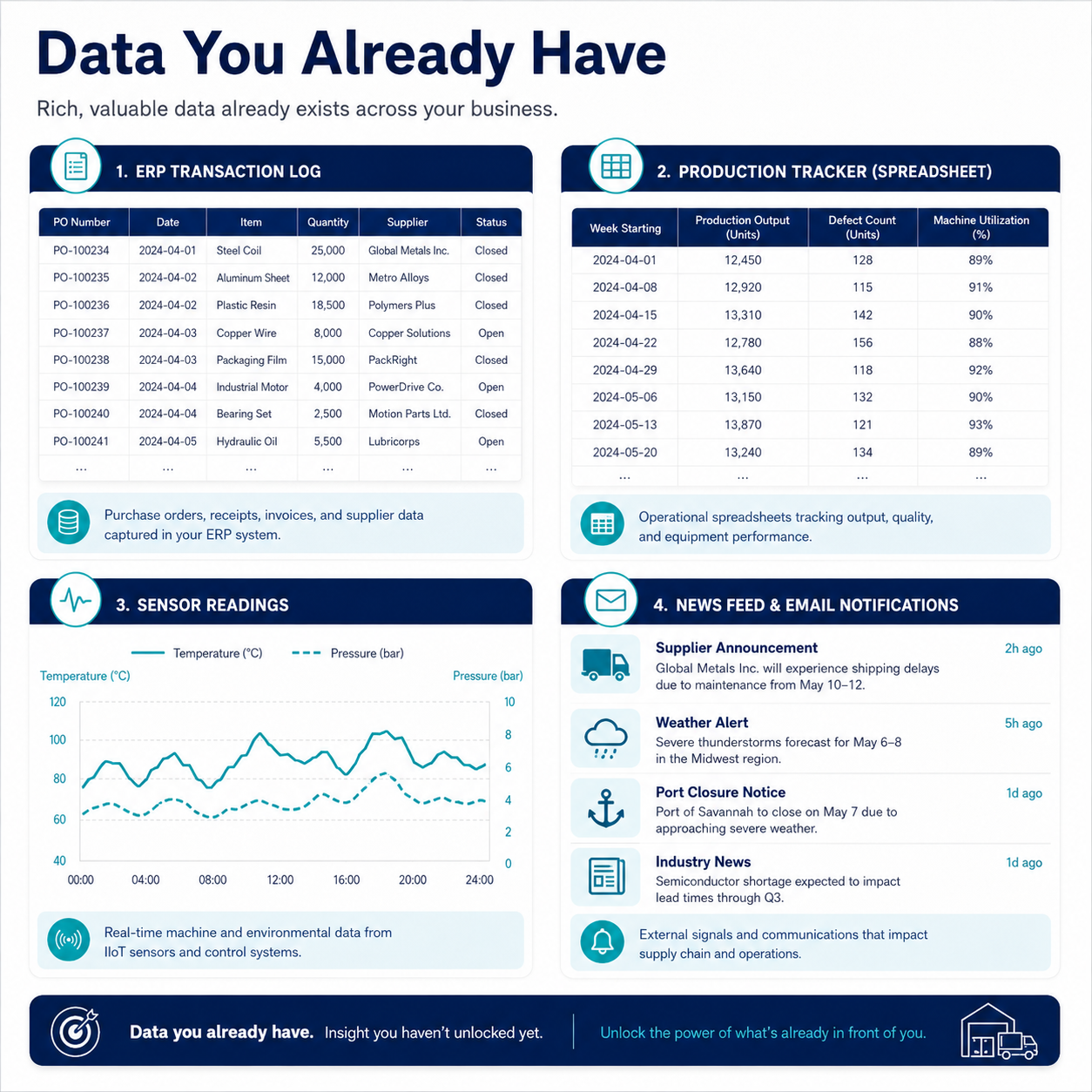
ERP transaction logs contain purchase orders, receipts, production orders, work order completions, quality inspection results, and shipping records. Every row has a timestamp, a quantity, a status, and often a reason code. This is gold for a learning system because it captures what actually happened, not what was supposed to happen.
Spreadsheet trackers live in every operations team. Weekly production summaries. Defect logs. Maintenance schedules. Capacity utilization reports. They are messy. Formats change. People make data entry errors. But they often capture information that never makes it into the ERP: workarounds, exceptions, informal metrics that the team actually uses to make decisions.
Sensor data from production equipment captures temperature, pressure, vibration, cycle time, and energy consumption. Modern machines generate hundreds of data points per minute. Even basic CNC machines log cycle times and error codes. This data reveals equipment degradation patterns long before a breakdown, and it exposes process variation that manual inspection misses entirely.
External data like commodity price indices, weather forecasts, port congestion reports, supplier financial filings, and even news mentions add context that internal systems cannot see. A supplier's on-time delivery rate means something different when you know they are operating in a region hit by a typhoon or facing a raw material shortage.
None of these data sources need to be perfect. Learning systems are tolerant of noise. Missing values. Inconsistent formats. They work with the data as it exists in the real world, not the idealized version that analytics teams describe.
What good data looks like
Tolerant does not mean indifferent. Data quality still matters enormously. The difference is that "good enough for learning" is a more practical standard than "perfect for analytics."
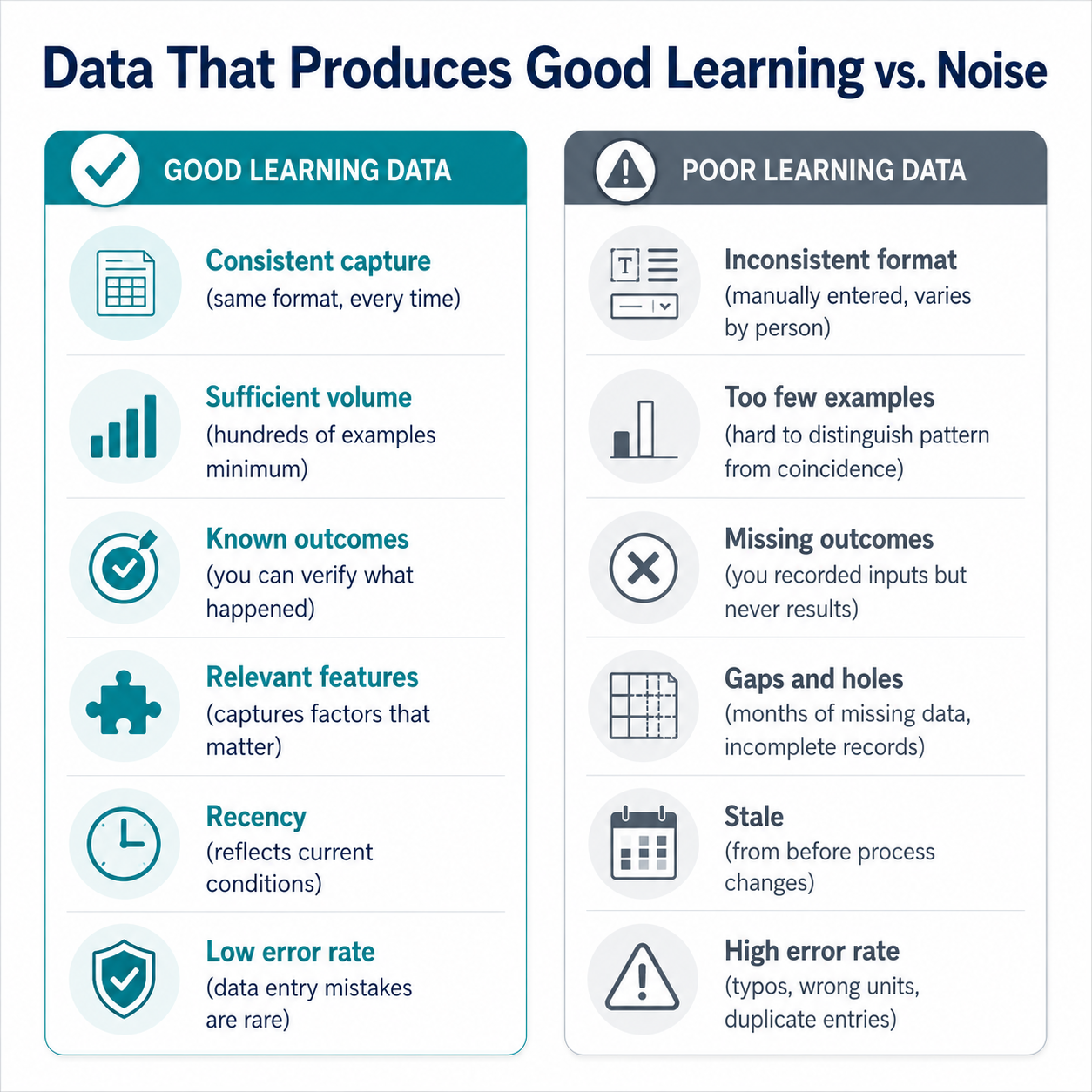
Consider what produces genuinely useful learning:
Consistent capture. The same fields, recorded the same way, every time. If one person logs supplier names as "Matsui Heavy Industries" and another as "M. Matsui Co," the system treats them as different suppliers. This is the most common data quality problem, and it is usually solvable with basic cleaning.
Sufficient volume. You need enough examples for the system to distinguish patterns from coincidence. For simple predictions (will this supplier be late?), a few hundred historical records often suffice. For complex ones (what will demand be across 2,000 SKUs next month?), you need thousands. But the baseline is lower than most people expect.
Known outcomes. This is critical. The system learns by comparing its predictions to what actually happened. If you have records of every purchase order but never recorded actual delivery dates, the system cannot learn about delivery performance. The most common gap: teams track inputs meticulously but never close the loop on outcomes.
Recency. Data from the current operating environment. If your processes changed significantly two years ago, data from before that change is less relevant. Not useless, but less weighted. The system should learn more from recent patterns and less from stale ones.
And what produces noise instead of insight:
Inconsistent formats. Manual entry with no standardization. Different people using different conventions. Fields that are sometimes filled and sometimes blank. This introduces noise that the system interprets as signal.
Missing outcomes. Recording decisions without results. You logged which supplier you chose for each PO, but you never scored the outcome (on-time, quality, total cost). Without outcomes, there is nothing to learn from.
Gaps and holes. Entire months with no data. Quarters where the team tracked things differently. Systems that were upgraded and broke the historical chain. Gaps force the system to learn from an incomplete picture.
High error rates. Typos in quantities, wrong units (kilograms versus pounds), duplicate entries, dates entered in different formats. Every error is a wrong lesson the system internalizes.
Why this matters for your team
Most operations leaders approach AI backward. They assume they need to collect new data before they can start. They launch data governance initiatives. They invest in better capture processes. They wait for the perfect dataset.
That is the wrong sequence. The more productive path is to start with the data you already have, apply learning systems to it, and see what patterns emerge. Even imperfect data reveals useful patterns if the volume is sufficient and the outcomes are recorded.
The reason is simple: the first learning project teaches you what data gaps actually matter. Before you use AI, you guess which data is important. After you use it, you know. The system tells you which features drive prediction accuracy. And those features reveal exactly which data gaps are worth filling.
This is the shift from data collection as a preparation activity to data collection as an improvement activity. You do not collect data to prepare for AI. You use AI to learn what data to collect next.
The practical starting point
Before investing in new tools or processes, run this simple assessment against your own organization:
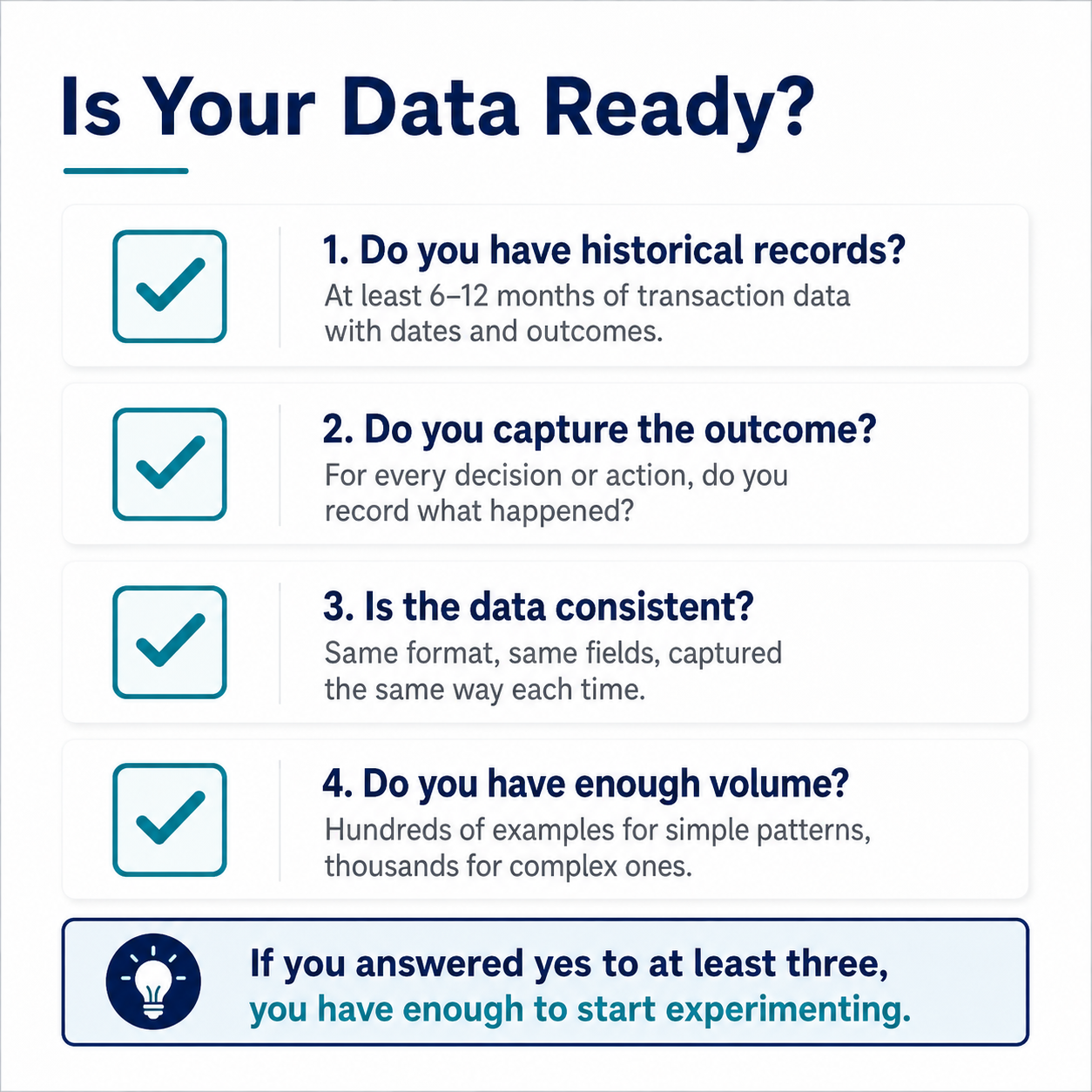
Do you have historical records? Look at the last 12 months of transaction data. Purchase orders with actual delivery dates. Production runs with actual output and yield. Quality inspections with pass/fail results. Maintenance work orders with completion times. Most ops teams have at least one of these data sources with hundreds of records.
Do you capture the outcome? For every decision, do you know what happened? If you assigned Supplier A to a PO, did the goods arrive on time and pass inspection? If you scheduled a job on Machine 3, did it complete in the expected time? Outcome data is the answer key that makes learning possible.
Is the data consistent? Does it use the same format, same fields, same conventions across the time period? Some inconsistency is normal and manageable. Systematic inconsistency (different formats in different quarters, or different teams using different systems) requires cleaning before learning.
Do you have enough volume? Count the actual records. If you place roughly 15 POs per week, that is about 750 POs per year. That is enough to start learning delivery patterns. If you run 200 production jobs per month, that is 2,400 jobs per year. That is enough to learn scheduling and yield patterns.
If you answered yes to three or more of these, you have sufficient raw material to begin. The barrier is not data scarcity. It is the decision to apply learning systems to what you already have.
Key takeaways
- AI "learning from data" is structurally similar to how humans build expertise from experience — seeing examples, recognizing patterns, making better calls over time — just operating at a scale far beyond human capacity.
- The learning process has two distinct phases: training (studying examples with known answers) and prediction (applying learned patterns to new situations). Understanding this split is essential for evaluating AI performance.
- Most operations teams already have enough data to start: ERP transaction logs, spreadsheet trackers, sensor readings, and external sources like weather and commodity prices.
- Good learning data has four characteristics: consistent capture, sufficient volume, known outcomes, and recency. The most common gap is tracking inputs without recording outcomes.
- The productive sequence is: start with existing data, apply learning systems, let the results reveal which data gaps matter, then fill those gaps. Do not wait for perfect data.
- If you have 12 months of historical records with outcomes, consistent enough format, and hundreds of examples, you are ready to experiment.
Next lesson: Is Your Data Actually Ready? A Practical Audit.